The Dragon’s Footprint: China’s Strategic Evolution in the Western Balkans
Introduction
While travelling through the Balkans, it is easy to spot the name of Chinese companies, especially related to infrastructure projects. Indeed, the presence of China in the Western Balkans has been increasing during the last few decades, with investments that shifted China’s position from a mere alternative investor to a systemic actor in the region, often considered to exploit gaps left by a slow EU enlargement process.
Despite an uneven distribution of influence, China’s presence in the region has raised multiple concerns, such as regarding its modus operandi and its implications for the EU accession process.
This article will outline China’s strategy in the Western Balkans, especially under the umbrella of the Belt and Road Initiative and the evolution of this framework. A later section will outline the importance of the Western Balkan region for China’s geopolitical strategy. Lastly, the Chinese presence in the various countries of the region will be analysed.
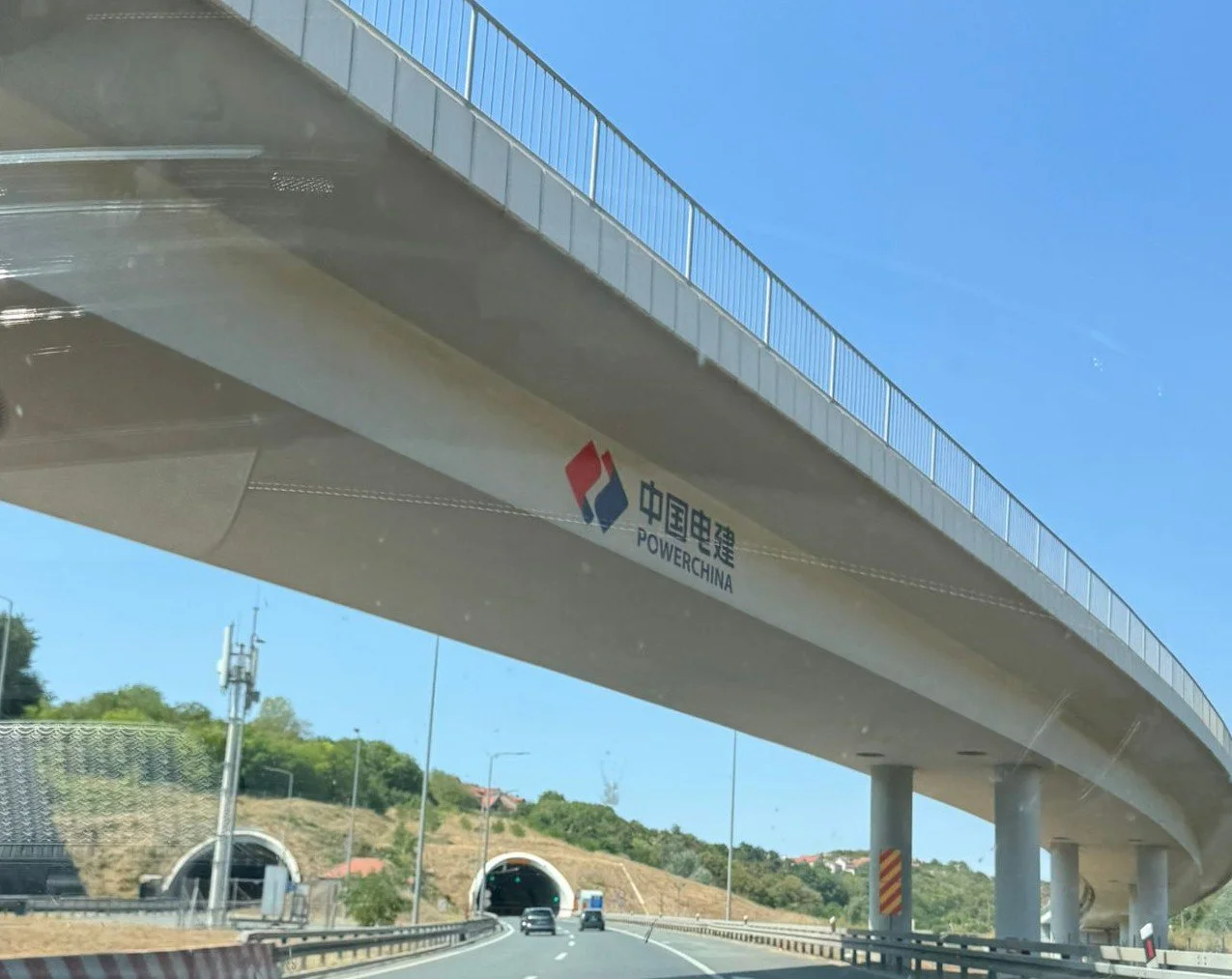
A Powerchina tag visible while travelling on the A1 (E75) highway next to Resnik neighbourhood, Belgrade, Serbia.
China’s Strategy in the WB6: 17+1 and The Belt and Road Initiative
To understand China’s presence and influence in the Western Balkans, it is important to start from its foreign policy strategy, which combines political influence with infrastructure projects.
The relationship between China and some of the Western Balkan countries was formally inaugurated in 2012, when the region became part of the 16 + 1 mechanism, later expanded to Greece, becoming 17 + 1. This framework established a cooperation for infrastructure development between China and Central, Eastern, and Southern European countries, from Greece to the Baltic states (LSE, 2021).
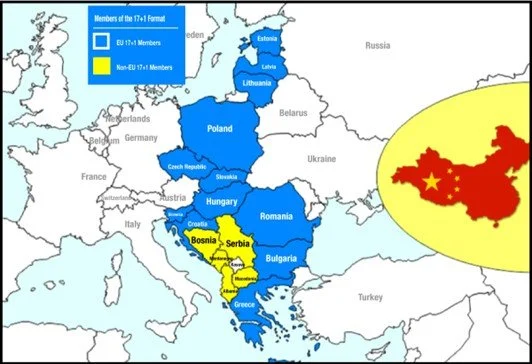
Map of the members of the 17 + 1 countries (EUCNC Center, 2022)
The initiative, however, quickly encountered unmet economic promises, underperformance, and geopolitical tensions, resulting in a weakened partnership. After the withdrawal of the Baltic states between 2021 and 2022, the framework turned into 14 + 1 (Lau, 2022). Today, the initiative is largely inactive, leaving space for Belt and Road Initiative-related projects.
Announced in 2014 by Chinese Leader Xi Jinping, the goal of the Belt and Road Initiative is to create a transport network all around the globe that serves as a preferential corridor for trade with China, increasing its access to resources and strengthening its ties with partner countries. Officially, the BRI promotes development, peace, and cooperation through connectivity projects (The State Council Information Office of the People’s Republic of China, 2023). In practice, it is an international infrastructure development strategy that functions by financing and constructing infrastructure as a cornerstone of China’s foreign policy to expand its influence. Within the Initiative, China offers to third countries the construction or renovation of hard infrastructure such as highways, ports, and railways, as well as soft infrastructure such as telecommunications and energy networks (Tsuji, 2023).
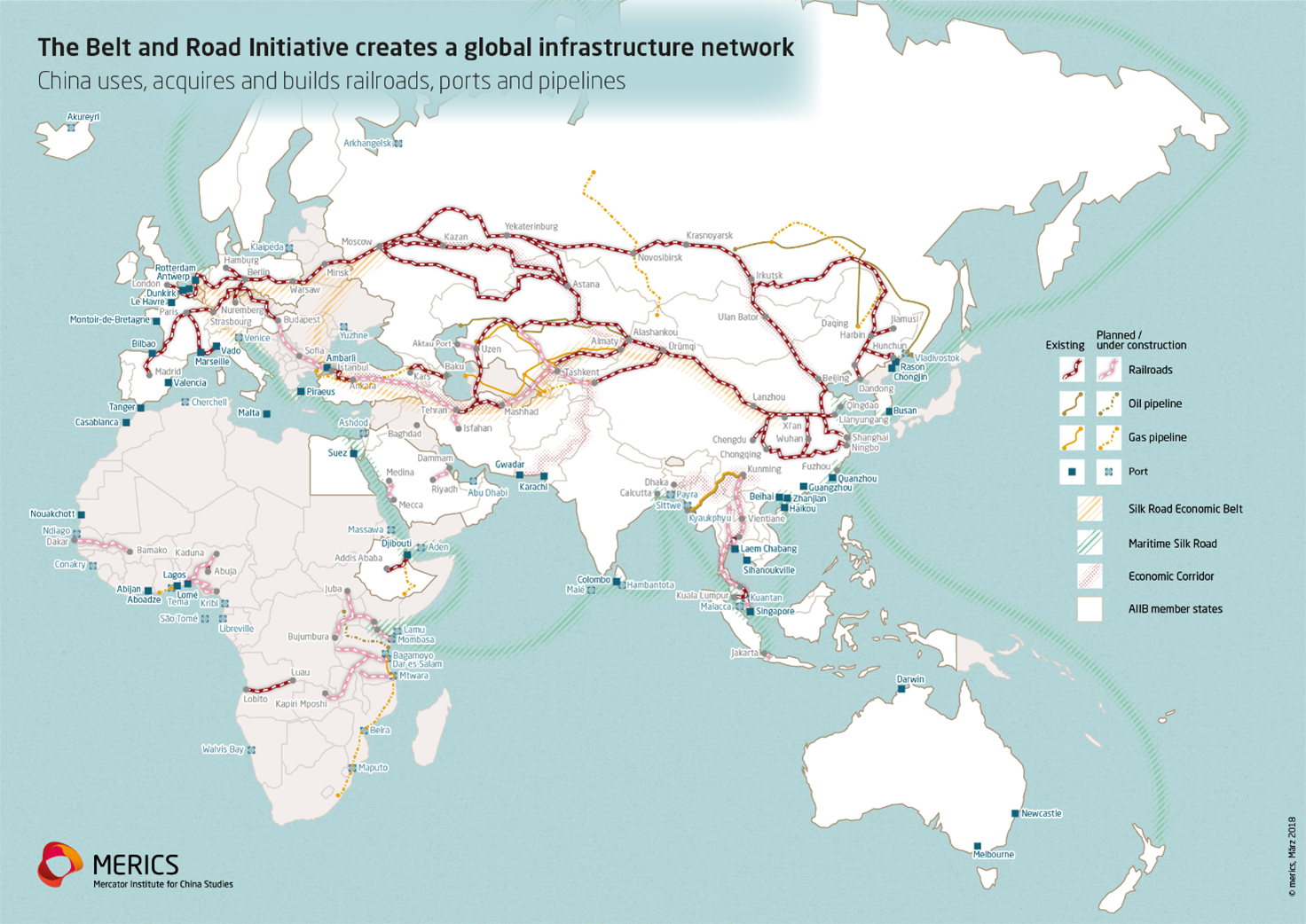
Map of the infrastructure projects under the Belt and Road Initiative (Mercator Institute for China Studies, 2018)
Despite the initial excitement, the projects carried out under the framework of the Belt and Road Initiative have shown multiple points of concern, such as on sustainable debt burdens on the contracting countries, environmental damage, lack of transparency, and geopolitical leverage (Dedaj, 2024).
Specifically, the projects present extremely expensive bills to the contracting countries, which are financed through loans from Chinese banks. Such loans have often been criticised for increasing debt vulnerabilities in several partner countries, reaching extreme cases such as the International Monetary Fund’s bailout of Sri Lanka (EFSAS, 2023). Therefore, high-interest loans with strict clauses in case of failed payment have created severe debt vulnerabilities for developing countries, potentially allowing China to gain control over strategic assets. In simple terms, Chinese companies and banks are guaranteed revenue through payment to the constructing company, loan repayment, and the operation of the infrastructure by the company in case of failed repayment.
Leveraging the institutional weaknesses of developing and transitioning countries, projects tagged BRI have often been the centre of corruption scandals involving local political elites, cases of procurement contracts signed behind closed doors, poor materials that led to quick deterioration, and serious delays in completion. Only in the Western Balkan region, hundreds of complaints and lawsuits have been filed against nearly 30 projects carried out by Chinese companies under the BRI, registering cases including damages to private properties, corruption of government officials, abuse of market power, pollution and environmental damage, and lack of transparency (Just Finance, 2024).
On the side of the regional elites, China’s “development without democratisation” model is certainly appealing to some. The fragmented democratisation and weak rule of law characterising the region are factors that benefit both Chinese companies and some local elites reported to be involved in corruption cases that facilitated the assignment of projects to Chinese enterprises (Mardell, n.d.).
Beyond Infrastructure: The Evolution of the BRI in the WB
The BRI initially expanded in the Western Balkans through large-scale infrastructure projects aimed at improving transport connectivity both within the region and between the region and continental Europe. Early flagship projects focused on the construction or renovation of highways, bridges, ports, and railways. Notable examples include the Belgrade-Budapest railway and major highway projects in Serbia and Montenegro, all financed through loans from Chinese banks and implemented by Chinese state-owned companies. Such investments were framed as contributing to the EU’s Trans-European Transport Network (TEN-T) extension into the Western Balkans, while simultaneously embedding the region into Chinese-led Eurasian logistics corridors (Gruebler, 2021).
In recent years, however, the focus of Chinese engagement under the BRI umbrella has increasingly shifted toward the energy sector. While early involvement included coal-fired power plants, the portfolio has gradually diversified into renewable energy, such as wind energy projects in Serbia and North Macedonia and solar investments in Albania. This shift reflects both Beijing’s gradual repositioning toward “Green BRI” narratives and the region’s need to align with EU climate requirements of the accession framework (Jahns et al., 2020).
Simultaneously, the BRI framework has expanded beyond physical infrastructure into the digital domain, described as the “Digital Silk Road”. Chinese technology firms such as Huawei and ZTE have played important roles in telecommunication modernisation, data centres, and surveillance infrastructure. Serbia has been at the centre of this digital expansion, with projects such as “Smart City” and “Safe City” in Belgrade, which employ facial recognition cameras, traffic monitoring, and integrated public security platforms, raising privacy standards concerns (Haxhixhemaji, 2025).
The presence of Chinese-funded data hubs and cloud infrastructure in the region has also been rising, possibly exposing regional data sovereignty to external powers and posing obstacles to EU digital standards alignment, such as on GDPR-like hurdles. The integration of Chinese digital infrastructure may complicate compliance with EU cybersecurity frameworks, creating structural tensions between economic cooperation with China and the digital regulatory convergence required for EU accession (Haxhixhemaji, 2025).
Security cooperation between China and the WB countries has also deepened, in particular with Serbia, which has received CH-92A combat drones and FK-3 air defence systems. The purchase marked the first export of such Chinese systems to a European country, consolidating Beijing’s security footprint in the region (Jankovic & Cvetkovic, 2026).
The Geopolitical Rush
At the door of the European Union, but still outside of it and its strict legislative frameworks, the Western Balkans represent an extremely strategic region for Chinese investments, allowing China to strengthen its presence and political influence, as well as develop direct trade routes to the EU (Zeneli, 2023).
Despite its major investments, China is not the sole actor engaging with the region, which also sees the EU as one of the main economic partners. Nevertheless, despite the lower interest rates, the stricter and more regularised character of EU investments and loans is not as attractive to local elites, creating a struggle for political influence and geopolitical alignment which the EU currently sees as indispensable (Stojadinović, 2025).
The heavy presence of China in the Western Balkans highlights questions related to another actor in the region: are China and Russia partners or competitors? While active on the same ground, Moscow and Beijing are considered to be parallel actors with partially overlapping interests rather than competitors (Daniel et al., 2024). Partners on the global stage, the two powers try to exert their influence in the region through different tools. While Russia mostly employs political and security leverages to prevent NATO and EU consolidation in the Western Balkans, China’s economic penetration and strategic positioning have long-term economic goals (Stanicek & Russell, 2022; Fenkart, 2021). However, it is important to mention one main divergence between the two powers’ strategies: Chinese interests benefit from regional stability as a condition for protecting investments and establishing its presence in the long-term (Tuysuzoglu, 2022); Russia prefers a situation of managed instability able slow the region’s EU and NATO integration (Stanicek & Russell, 2022).
Outlook on the countries
Albania
Albania has generally successfully avoided engaging in high-debt, large-scale infrastructure investments with China, focusing on limited and smaller-sized projects for a total of around €650 million. Officially focused on 8 projects, the economic relationship between Albania and China is characterised by cooperation projects such as the renovation of the Tirana airport, the takeover of a copper mine and an oil field by Chinese companies, and the purchase of Chinese Sinovac Covid-19 vaccines (Balkan Insight, n.d.). Instead of opening the country to big projects, Prime Minister Edi Rama preferred maintaining simple diplomatic relations and dialogue with China (Pulaj, 2023).
Geopolitically, Albania’s NATO membership and active EU accession process necessarily push the country towards a careful balancing of its relations with China as well as other external actors. Albania is quickly aligning with EU legislation required for its membership. In such a case, trade between Albania and China would be regulated according to EU legislation.
Bosnia and Herzegovina
Amounting to an estimated value of €5 billion for 29 projects, Bosnia and Herzegovina is the second most engaged country in the region with China. Here, Chinese companies have expanded into large-scale projects in road infrastructure, such as the Sarajevo-Prijedor highway, and power plants, such as the Tuzla Block 7 Thermal Power Plant and the Ulog Hydropower plant (Balkan Insight, n.d.).
Kosovo
Kosovo is the only “absentee” in the region. The country has not joined any cooperation framework with China mainly because China does not recognise its sovereignty. Nevertheless, there is increasing economic engagement and bilateral trade between the two economies, and Chinese firms have bid for infrastructure projects in the country (European Council on Foreign Relations, 2022).
Montenegro
Montenegro has a total of nine China-led projects on its territory, with an estimated value of €2.45 billion. The engagement is mainly focused on high-investment infrastructure and power plants, such as the construction of the Bar-Boljare highway, the upgrade of the Pljevlja I power plant, the rehabilitation of the Kolašin-Kos railway, and the renewal of ship fleets (Balkan Insight, n.d.).
The projects increasingly impacted Montenegro’s debt, temporarily exceeding 100% of the country’s GDP in 2020-2021 and consequently raising concerns about dependency on China. Serious infrastructure developments also raised questions about their environmental impact, resulting in pollution of rivers and adjacent territory (Muller, 2024).
North Macedonia
North Macedonia has contracted Chinese companies for 15 projects on its territory, with a cost of around €654 million. BRI projects in the country primarily focus on infrastructure and transport, connecting North Macedonia to the China-Europe Land-Sea Express Route. Key projects, constructed by Powerchina and Sinohydro via Chinese loans, include the Miladinovci-Štip and Krupište-Kočani expressways, and the ongoing Kičevo-Ohrid highway.
The Kičevo-Ohrid highway section has repeatedly been discussed due to poor planning, delays, and lack of procurement and contract transparency, with the signature happening behind closed doors. Despite the highway remaining incomplete after more than 10 years of work, the contract to Sinohydro has been extended, and the company was also awarded two other projects in the country (Dragana Petrushevska, 2024).
Serbia
Serbia is considered China’s Hub of operations in WB, with 61 projects completed or initiated out of 130 in the whole region, for a total estimated value of €18 billion. Among the infrastructure developments, the country hosts the Budapest-Belgrade railway, which is close to opening to public transport after almost 10 years of work, the E-763 highway, and Pupin’s Bridge (Trivić, 2024).
In fact, between 90 and 96% of Chinese Foreign Direct Investment in the Western Balkans is concentrated in Serbia (Jovanović, 2025). This solid relationship between the two countries is facilitated by the strong political ties rooted in mutual support on key geopolitical issues, such as Serbia’s stance on the One China policy, acknowledging Beijing’s claims on Taiwan, and China’s non-recognition of Kosovo’s independence (Martino, 2025). Serbia’s regulatory and investment environment also facilitates China’s presence in the country, thanks to pro-investment incentives, flexible regulatory procedures, and a favourable labour market and procurement environment. Nevertheless, most of the investments are considered to benefit environmentally and socially dangerous sectors, such as mining and low-quality manufacturing (Jovanović, 2025).
Conclusion
Chinese engagement in the Western Balkans has evolved from transport infrastructure projects to a multidimensional presence encompassing energy transition, digital governance, and security cooperation. What began as connectivity investments has gradually embedded China within key sectors of the countries of the region.
This expansion reflects not only Beijing’s strategic ambitions but also the institutional and political environment of the Western Balkans, where a slow and highly conditional EU accession process increases the interest in alternative sources of financing. Additionally, a weak rule of law and transparency measures in the Western Balkan countries favour certain local authorities who achieve the development of heavy infrastructure through flexible, and sometimes corrupt, processes.
As a result, China’s presence appears less as a temporary geopolitical trend and more as a long-term structural actor shaping the region’s economic and political developments. This deepening diversification strengthens economic interdependence but also generates strategic dilemmas for candidate countries navigating between Chinese investment and strict EU regulatory alignment.
Today, China’s presence poses a series of questions about the propriety of local procurement rules, the economic and environmental sustainability of such projects, the morality of the systems used, especially in the case of digital and security infrastructure, and the effectiveness of EU-led initiatives aiming to align the region with its geopolitical positioning.
References
Balkan Insight. (n.d.). China in the Balkans. China in the Balkans. https://china.balkaninsight.com/
Daniel, J., Švec, J., Laryš, M., & Musil, P. A. (2024, October 31). External actors’ engagement in the Western Balkans and Eastern Europe. Re-Engage | a Horizon Europe Project. https://re-engaging.eu/external-actors-engagement-in-the-western-balkans-and-eastern-europe/
Dedaj, D. (2024, December 9). China’s Belt and Road Initiative: A Double-Edged Sword for the Pacific Region – ITSS Verona. ITSS Verona. https://www.itssverona.it/chinas-belt-and-road-initiative-a-double-edged-sword-for-the-pacific-region
Dragana Petrushevska. (2024, June 11). Despite Delay and Scandal, Chinese Firm Wins More Work in North Macedonia. Balkan Insight. https://balkaninsight.com/2024/06/11/despite-delay-and-scandal-chinese-firm-wins-more-work-in-north-macedonia/
EFSAS. (2023). As suspense over IMF bailout ends to its advantage, Sri Lanka must prioritize reforms aimed at redirecting money to the poor. Efsas.org. https://www.efsas.org/commentaries/imf-bailout-sri-lanka-march-2023/
EUCNC Center. (2022). The 17+1 Initiative. Eu-Cnc.org. https://eu-cnc.org/business/the-17-1-initiative
European Council on Foreign Relations. (2022, March 16). Kosovo. ECFR. https://ecfr.eu/special/china-balkans/kosovo/
Fenkart, S. (2021, November 29). China’s Influence in the Western Balkans: Partnership or confrontation? Institute of New Europe. https://ine.org.pl/en/chinas-influence-in-the-western-balkans-partnership-or-confrontation/
Gruebler, J. (2021). China connecting Europe? Asia Europe Journal. https://doi.org/10.1007/s10308-021-00616-4
Haxhixhemaji, A. (2025, May 15). China’s Digital Silk Road in the Western Balkans: Threat or Opportunity? – chinaobservers. Chinaobservers. https://chinaobservers.eu/chinas-digital-silk-road-in-the-western-balkans-threat-or-opportunity/
Jahns, H., Emmerich, M., Stojiljkovic, M., Jelisic, S., Rink, S., & Löffler, K. (2020). GREENING BRI PROJECTS IN THE WESTERN BALKAN COUNTRIES Greening BRI projects. https://www.fs-unep-centre.org/wp-content/uploads/2020/11/2020-11-02_FS-UNEP-Centre_Greening-BRI-projects-in-Western-Balkan-Countries_study.pdf
Jankovic, J., & Cvetkovic, L. (2026, January 7). Serbia Deepens Military Ties With China Through Drones, Air Defense Systems. RadioFreeEurope/RadioLiberty; RFE/RL. https://www.rferl.org/a/serbia-china-military-cooperation-drones-air-defense-security/33626646.html
Jovanović, B. (2025, June 12). What’s driving Chinese FDI in the Western Balkans – and what should be done about it? Wiiw.ac.at. https://wiiw.ac.at/what-s-driving-chinese-fdi-in-the-western-balkans--and-what-should-be-done-about-it-n-685.html
Just Finance. (2024). Protests and criminal complaints in the Western Balkans. In https://justfinanceinternational.org/wp-content/uploads/2024/05/balkan-map-all.pdf.
Lau, S. (2022, August 11). Down to 14 + 1: Estonia and Latvia quit China’s club in Eastern Europe. POLITICO. https://www.politico.eu/article/down-to-14-1-estonia-and-latvia-quit-chinas-club-in-eastern-europe/
LSE. (2021). 17+1: China’s Foreign Policy in Central Europe. London School of Economics and Political Science; LSE. https://www.lse.ac.uk/ideas/podcasts/chinas-foreign-policy-in-central-europe
Mardell, J. (n.d.). Asia Policy Brief - China’s Economic Footprint in the Western Balkans. Www.bertelsmann-Stiftung.de. https://www.bertelsmann-stiftung.de/en/our-projects/germany-and-asia/news/asia-policy-brief-chinas-economic-footprint-in-the-western-balkans
Martino, F. (2025, October 18). China goes to Serbia: infrastructure and politics - Osservatorio Balcani Caucaso Transeuropa. Osservatorio Balcani Caucaso Transeuropa. https://www.balcanicaucaso.org/en/cp_article/china-goes-to-serbia-infrastructure-and-politics/
Mercator Institute for China Studies. (2018, June 7). Mapping the Belt and Road initiative: this is where we stand | Merics. Merics.org. https://merics.org/en/tracker/mapping-belt-and-road-initiative-where-we-stand
Muller, N. (2024, January 13). Montenegro’s Scandal-ridden Chinese Road. Thediplomat.com; The Diplomat. https://thediplomat.com/2024/01/montenegros-scandal-ridden-chinese-road/
Pulaj, A. (2023, March 2). Zero benefits for Albania from China’s Belt and Road Initiative. Global Voices. https://globalvoices.org/2023/03/02/zero-benefits-for-albania-from-chinas-belt-and-road-initiative/
Stanicek, B., & Russell, M. (2022, June 9). Russia’s influence in the Western Balkans. Epthinktank. https://epthinktank.eu/2022/06/09/russias-influence-in-the-western-balkans/
Stojadinović, S. (2025, April). The EU’s and China’s grants and loans in the Western Balkans. Wiiw Policy Notes; The Vienna Institute for International Economic Studies, wiiw. https://ideas.repec.org/p/wii/pnotes/pn92.html
The State Council Information Office of the People’s Republic of China. (2023, October). Full Text: The Belt and Road Initiative: A Key Pillar of the Global Community of Shared Future. China-Embassy.gov.cn. https://it.china-embassy.gov.cn/ita/ljzg/202310/t20231023_11166421.htm
Trivić, S. (2024, March 29). The Belt and Road Initiative and its Impact on Serbia: A Delicate Balance. Blue-Europe.eu. https://www.blue-europe.eu/analysis-en/full-reports/the-belt-and-road-initiative-and-its-impact-on-serbia-a-delicate-balance/
Tsuji, C. (2023, November 22). Belt and Road Initiative | Asian development project | Britannica. Www.britannica.com. https://www.britannica.com/topic/Belt-and-Road-Initiative
Tuysuzoglu, G. (2022). Chinese Impact in the Western Balkans: the Effect of the Belt and Road Initiative on the EU’s Normative Role. Codrul Cosminului, 28(1), 171–202. https://doi.org/10.4316/cc.2022.01.08
Zeneli, V. (2023, June 23). Chinese Influence in the Western Balkans and Its Impact on the Region’s European Union Integration Process | IWM WEBSITE. Www.iwm.at. https://www.iwm.at/europes-futures/publication/chinese-influence-in-the-western-balkans-and-its-impact-on-the-regions