A Regional Cooperation Lecture by the Danube
Introduction
“A unifying symbol: a river of hope, inspiration, and cliché”.
(Kaplan, 2005)
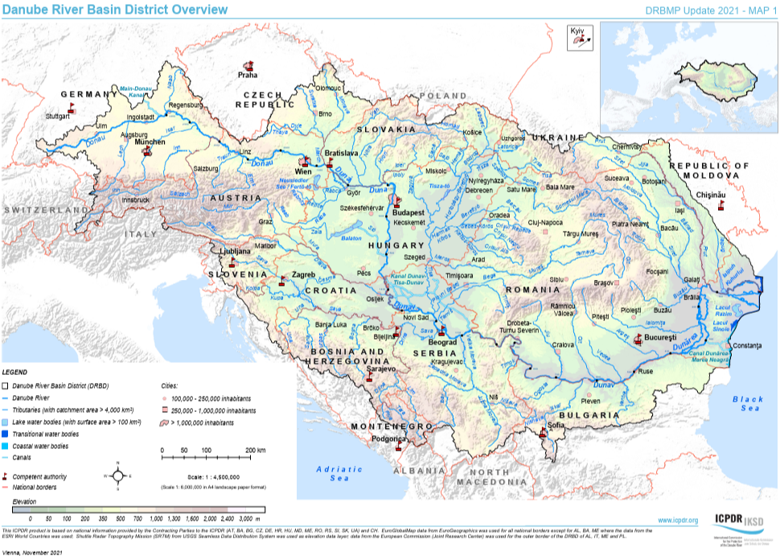
With its 2,850 kilometres, crossing 10 different countries from central Europe to the Black Sea, with over 300 tributary streams and rivers, and 19 countries making part of its basin, the Danube represents a resource of fundamental value in terms of biodiversity, transport, and economic development. In the Western Balkans, the Danube only crosses Serbia, but one of its major tributaries, the Sava River, marks the border between Croatia and Bosnia and Herzegovina, and Montenegro also benefits from its basin.
Offering a unique natural landscape with biodiversity to be preserved, the Danube’s basin represents a major economic opportunity to the communities that inhabit it. From the Black Forest to the Black Sea, the Danube River basin is home to 79 million people (ICPDR, n.d.-b). Although no single aggregate GDP figure exists for the entire river itself, water, fish, gravel, agricultural cultivation on its banks, and transport are examples of resources and activities that sustain the Danube economies.
This article will outline the importance of the Danube starting from a historical lens, the key policy themes and challenges surrounding it, and the consequences of climate change on its water levels and on the economic activities that rely on it.
A Brief Historical Lens
Throughout history, the Danube has represented an important symbol of international connectivity and a major transport and trade network, calling for bilateral and international agreements between states to guarantee the movement of passengers and goods. Some examples are the 1616 Austro-Turkish Treaty and the 1856 Treaty of Paris.
Signed in 1616, the Austro-Turkish Treaty granted the right to navigate the Ottoman middle and lower Danube to the Habsburg Empire. Similarly, the 1774 Treaty of Küçük Kaynarca marked the end of a Russian-Ottoman war, granting the use of the lower Danube to the Russians (Danube Watch, 2014).
Ending the Crimean War, the 1856 Treaty of Paris established the European Commission of the Danube. Including the riparian countries and Western powers in what can be considered the first international organisation regulating the Danube River, the Commission aimed to guarantee freedom of navigation and commerce, prevent insecurity, maintain the basin and its infrastructure, as well as limit Russia's dominant influence in the Danube deltas (Danube Watch, 2014). The Commission, therefore, embodied the duties of a technical and political collective instrument to reach common security and geopolitical goals. Originally planned to work for only two years, the Commission eventually operated until 1948 (Ardeleanu, 2020).
Following the events of the First and Second World Wars, the 1948 Danube River Conference in Belgrade brought the control of navigation on the Danube River exclusively under the riverine countries. Three administrations were created: the umbrella Danube Commission; the bilateral Romania-USSR administration of the stretch from Brăila to Sulina; and the Romania-Yugoslavia bilateral administration of the Iron Gates between the two countries, where the Danube divides Novi Sip in Serbia and Gura Văii in Romania (Danube Watch, 2014).
In Serbia, the Danube flows for 588 km, representing a strategic commercial route. In 1999, during the NATO bombing of former Yugoslavia, navigation on the Danube River in Serbia suffered from a total blockade due to the destruction of bridges in Novi Sad. Such events resulted in a halt to transport and commerce through the river, causing serious economic losses for Serbia, but also affecting neighbouring countries, such as Ukraine, Romania, Slovakia, and Bulgaria, which had also lost their access to this transport corridor towards Central Europe (Ascherson, 1999).
These historical landmarks clarify that the Danube represents much more than just a river, but it is an economic and geopolitical asset.
Key Policy Themes
With its economic potential come also many policy themes such as connectivity and transport, energy and climate, environment and water governance, and security and geopolitics.
As an inland waterway navigation, with 2 415 km navigable out of its 2 850 km, and linking Western Europe with the Black Sea, the Danube forms the backbone of the Rhine-Danube Trans-European Transport Network (TEN-T) Corridor. On its waters, millions of tonnes of commercial cargo are carried every year, representing an essential corridor for European trade (European Commission, n.d.). The Danube is also included in the EU’s Economic and Investment Plan for the Western Balkans as part of flagship projects meant to foster sustainable transport and waterway infrastructure while improving connectivity. Among the various projects funded under this initiative was the removal of several ships sunk on the bed of the river during WWII in Prahovo, Serbia, allowing for facilitated and increased traffic on the river (Kovačević, 2024). Flowing through so many countries, the Danube’s connectivity value is unique in Europe.
Thanks to infrastructure such as the Iron Gates between Serbia and Romania, the Danube’s water flow generates hydropower, a key energy source in Central and Eastern Europe. With 18 major hydroelectric river power plants and dams on the main stem of the river, and over 700 others across all its tributaries, the total electricity generation capacity is approximately 30 000 megawatts (DRP-MF, 2025). The Iron Gates I and II, located between Serbia and Romania, are the largest dams and reservoir system on the entire Danube River, and are expected to further develop by 2036 with a pumped-storage plant (Pavlova, 2026). Nevertheless, the massive exploitation of hydropower, despite contributing to energy transition commitments, also creates pressure on river flows, reducing the basin’s biodiversity, increasing water pollution, and further exacerbating drought events and low water levels (WWF, 2020).
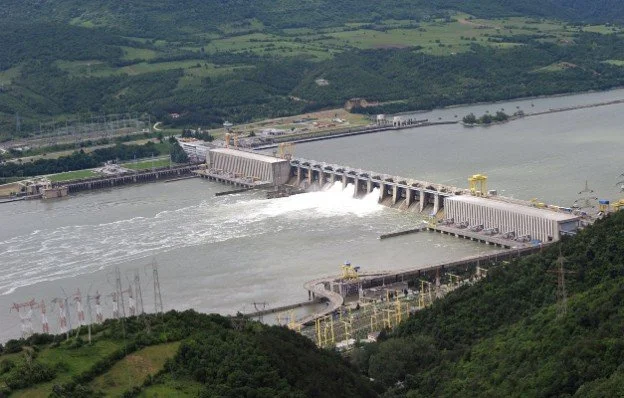
Iron Gate I (DALIA, 2021)
The extension of the river led to the establishment of a partnership between the countries it flows through, allowing for common decision-making on a common resource. Founded in 1998 and with 14 full contracting parties, the International Commission for the Protection of the Danube River (ICPDR) acts as the main platform for cooperation, policy coordination and transboundary water management. Based on the EU Water Framework Directive as the legal and environmental standard, the ICPDR aims to address five main challenges: organic substance pollution, nutrient pollution, hazardous substance pollution, hydro-morphological alterations, and flood risk management (ICPDR, n.d.).
Signalling its geopolitical and connectivity character, the war in Ukraine also affected the activities that relied on the Danube. As a strategic corridor that connects Eastern and Central Europe, the Danube and its ports represent grain and agricultural export routes from Ukraine towards Central Europe. Repeated Russian attacks on the Black Sea and on river ports, such as the Port of Izmail, Ukraine’s largest export hub on the Danube River, located in the Odesa Oblast near the Romanian border, have hindered Ukrainian agricultural exports towards Central Europe (Reuters, 2026).
What the Danube tells us about EU Integration
Adopted more recently, the 2011 EU Strategy for the Danube Region is a macro-regional strategy developed by the European Commission and the Danube Region countries. Aiming to cooperate to address common challenges, the Strategy entails 12 Priority Areas divided into 4 pillars, focused on “strengthening the region, connecting the region, building prosperity, and protecting the environment”. Included in the 14 participating countries are also three Western Balkan countries, namely Bosnia and Herzegovina, Montenegro, and Serbia (EUSDR, n.d.).
The EUSDR serves the function of a soft-integrating tool for candidate and neighbouring countries. Without imposing heavy legal mandates, it fosters transnational cooperation across the 14 participating countries, relying on multi-level governance and coordinating already existing institutions, such as local and national authorities, instead of creating new ones. Additionally, it does not rely on a dedicated budget, but is optimised into existing frameworks, such as the European Structural and Investment Funds (EUR-Lex, 2021).
The EUSDR puts Bosnia and Herzegovina, Montenegro, and Serbia at the same table as EU member states. If, on the one hand, this configuration has the potential to bring some candidate countries closer to the EU and its legislation without strict conditions, on the other hand, the lack of strict obligations also represents a risk for the EU, which cannot foresee whether its standards will be followed. Nevertheless, the combination with the ICPDR, firmer and resting on a binding convention, has the potential to mitigate this risk. The ICPDR embodies a platform for implementing the transboundary aspects of the Water Framework Directive, for both EU and non-EU states alike. This structure can further align the countries of the basin to the EU acquis before accession, especially on Chapter 27 – Environment and Climate Change.
Although the river’s themes do not set the pace of negotiations, which more heavily rely on topics such as rule of law and public administration, international and regional cooperation required for the management of the Danube’s basin can still be considered within the entirety of initiatives that bring the region closer to the EU.
Real consequences of climate change
The Danube’s floodplains are estimated to generate about € 500 million every year thanks to activities such as flood and drought management, climate change adaptation, water purification, fish production, reed harvesting and recreation. The basin wetlands also serve as “climate buffers”, storing water in case of drought and soaking up excess water, reducing flood risks (WWF, 2014). Nevertheless, despite adaptation initiatives and projects being developed throughout the river basin, climate change increasingly affects the Danube region, and the past summer has brought new examples of real consequences.
Successive heatwaves since May pushed water levels to record lows in multiple sections of the river. At Paks, in Hungary, where the water of the Danube is the sole source of cooling water for a nuclear power plant, the level fell to a 30-year record low, causing the plant to scale back its output to prevent overheating, operating at only 10-25% of its capacity (Gozzi, 2026). In order to artificially raise the water level at the cooling intake pump, Hungarian authorities sank rock-loaded barges across the river (Gkritsi, 2026).
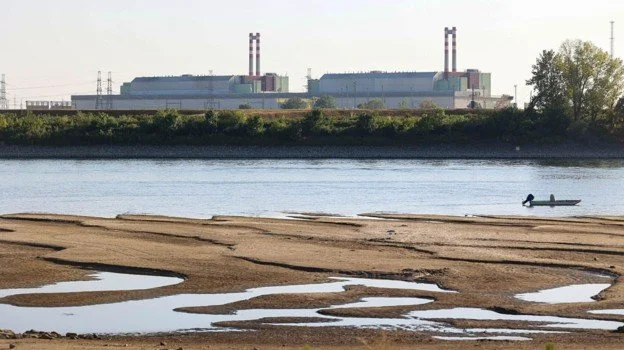
Paks nuclear plant during the Danube’s drought (Watson & Tesija, 2026)
Downstream, low water levels disrupted the operations of Serbia’s Iron Gates plants, which ran at only 20% and 30% capacity, respectively. Output from May to July 2026 was the lowest since the plants entered service, also affecting Romania’s and Bulgaria’s electricity production as a spillover effect (AFP, 2026).
The drought also hit the navigation of cargo and passenger ships along the river, causing delays and forced stops due to insufficient water levels. Furthermore, serious losses in fishing were registered, and scarce soil moisture and a strong reduction in water supply for irrigation hindered agricultural activities along the basin (Tasci-Steinebach, 2026).
The heatwaves registered during the past summer further highlighted the importance of the Danube for human and economic activities. As climate change is not expected to revert any time soon, the scenario of even hotter summers becomes more probable, calling for immediate action in developing mitigation and adaptation projects that will guarantee the continuation or the conversion of activities that support local economies.
Conclusion
Is the Danube a symbol of cooperation, or just a cliché? History suggests a bit of both. Despite major frameworks on the river coming to a rupture, international agreements and cooperation to regulate shared exposure were soon proven to be necessary.
While for centuries the Danube represented an essential resource, the consequences of climate change, increasing in number and severity, risk destroying such activities that rely on its waters and basin, sustaining local and national economies.
This summer’s drought was another moment of shared exposure. Authorities were forced to take extreme measures to guarantee the functioning of key infrastructure, which was, regardless, hit by limited operability due to low water levels. Despite recently developed mitigation and adaptation projects, the basin’s institutions and international cooperation frameworks, built for pollution management, navigation, and soft policy coordination, were not designed for shocks like this.
For the Western Balkans, the lesson is double. Danube cooperation frameworks have the potential to bring Bosnia and Herzegovina, Montenegro and Serbia closer to EU standards without strict obligations. Now, climate change consequences are raising the bar, calling for tighter cooperation to face common challenges.
References
AFP. (2026, August 2). Drought forces Serbia to cut back power generation. Citizen Digital. https://citizen.digital/article/drought-forces-serbia-to-cut-back-power-generation-n387589
Ardeleanu, C. (2020). The European Commission of the Danube, 1856–1948: aN experiment in international administration. Balkans Studies Library. https://d1wqtxts1xzle7.cloudfront.net/75634378/WBHR_2021_2_07_Recenze_Zprava-libre.pdf?1638534075=&response-content-disposition=inline%3B+filename%3DConstantin_ARDELEANU_The_European_Commis.pdf&Expires=1791121137&Signature=VhvEQWCfR8XBf7ik~BaOV-4Sfj38XrhgbBpm002c4VD2Am1s-EeWm~7J1coMwgxoqFYSdsovXxRwCjqKibwhXVA68B-Vd4InS4-l4Mbk6TE1IgnVG2zLO4Vur50i6tTp~NKQL3xqVGIDED4CukQ6sEJDl8vagKzEwgUStFT2PVxTGx8c22tak5nZzPV8DbeRQhptAVl9-naIbDPypMvZ~-5nP19f1UA2WbFJBjZPGsJhZKg3tepZZSE8-7g5gOw-Ns7AYchVt5A8-BmKzNxDEKdotdrr~e0Qy2s-5HaG29p8vpPFgAV9qOcEJmdXJIvcARdnPVLMez0LX-E1P0TPJg__&Key-Pair-Id=APKAJLOHF5GGSLRBV4ZA
Ascherson, N. (1999, November 24). Damning the Danube. The Guardian. The Guardian. https://www.theguardian.com/theguardian/1999/nov/24/guardianweekly
DALIA. (2021). DALIA project | Danube Region Water Lighthouse Action - DPS 6. Dalia-Danube.Eu. https://www.dalia-danube.eu/demo-sites/dps-6
Danube Watch. (2014, January). The flow of danube cooperation: A history of shared responsibility | ICPDR - International Commission for the protection of the Danube river. Www.Icpdr.Org . https://www.icpdr.org/publications/flow-danube-cooperation-history-shared-responsibility
DRP-MF. (2025). Dams and reservoirs. Undp-Drp.Org. https://www.undp-drp.org/drp/danube_dams_and_reservoirs.html
EUR-Lex. (2021, April 9). European Union Strategy for the Danube Region. https://eur-lex.europa.eu/EN/legal-content/summary/european-union-strategy-for-the-danube-region.html
EuroAccess. (n.d.). EU-Strategy for the Danube Region (EUSDR). EuroAccess. Retrieved https://www.euro-access.eu/en/macroregions/eusdr
European Commission. (n.d.). Rhine-Danube Core Network Corridor - European Commission. Transport.Ec.Europa.Eu. Retrieved October 16, 2026, from https://transport.ec.europa.eu/other-pages/transport-basic-page/rhine-danube-core-network-corridor_en
EUSDR. (n.d.). EUSDR. EUSDR - Danube Strategy Point. Retrieved October 4, 2026, from https://danube-region.eu/
Gkritsi, E. (2026, August 15). Hungary uses sunken barges to raise Danube river to keep nuclear plant going. Politico. https://www.politico.eu/article/hungary-barge-danube-river-nuclear-power-plant-paks/
Gozzi, L. (2026, July 30). Danube’s record low levels force shutdown of Hungary’s only nuclear plant. BBC. https://www.bbc.com/news/articles/cn0nqv05g0do
ICPDR. (n.d.-a). About US | ICPDR - International Commission for the protection of the Danube river. Www.Icpdr.Org. Retrieved October 16, 2026, from https://www.icpdr.org/about-icpdr/framework/about-us
ICPDR. (n.d.-b). Countries of the Danube river Basin | ICPDR - International Commission for the protection of the Danube river. Www.Icpdr.Org. Retrieved October 16, 2026, from https://www.icpdr.org/danube-basin/countries
Jolović, D., & Dejan, J. (2016, August 19). Ten economic benefits of the Danube for Serbia. Danubius. https://danube-cooperation.com/danubius/2016/08/19/ten-economic-benefits-danube-serbia/index.html
Kaplan, R. D. (2005). Balkan ghosts : A journey through history. Picador.
Kovačević, G. (2024, September 18). Serbia clears WWII ships from Danube to allow trade to flow. European Investment Bank. https://www.eib.org/en/stories/serbia-danube-navigation-wrecks-world-war-ii
Pavlova, I. (2026, July 16). Serbia, Romania sing MoU on info exchange for iron gate III. SeeNews. https://seenews.com/news/serbia-romania-sing-mou-on-info-exchange-for-iron-gate-iii-1298171
Reuters . (2026, August 13). Russia attacks Ukrainian port on Danube, Zelenskiy urges US to send patriots. Reuters. https://www.reuters.com/world/russian-attack-sets-ablaze-ukraines-izmail-port-infrastructure-regional-2026-08-13/
Tasci-Steinebach, A. (2026, August 2). Danube dries up as drought paralyzes Europe’s lifeline. Dw.Com. https://www.dw.com/en/danube-dries-up-as-drought-paralyzes-europes-lifeline/g-78179821
Watson, N., & Tesija, V. (2026, August 4). Hungary narrowly avoids full nuclear shutdown; Slovenia plant still at full capacity. Balkan Insight. https://balkaninsight.com/2026/08/04/hungary-narrowly-avoids-full-nuclear-shutdown-slovenia-plant-still-at-full-capacity/rd/
WWF. (2010). New life for the Danube. Www.Wwf.Eu. https://www.wwf.eu/?188201/New-life-for-the-Danube
WWF. (2014). The invisible economic benefits of the Danube. Panda.Org. https://wwf.panda.org/es/?224651/The-invisible-economic-benefits-of-the-Danube
WWF. (2020). Blue river. Panda.Org. https://wwf.panda.org/discover/knowledge_hub/where_we_work/black_sea_basin/danube_carpathian/our_solutions/freshwater/danube_river_basin/