Danger Breathing: Air Pollution in the Western Balkans
Introduction
What do Novi Pazar, Skopje and Sarajevo have in common? Beyond being cities in the Western Balkans, they are sadly characterised by some of the highest levels of air pollution in Europe. With PM2.5 and PM10 contamination often exceeding safe thresholds, many Western Balkan cities, from capitals to smaller towns, regularly face unhealthy levels of air pollution, even reaching top positions in global rankings during winter months, provoking serious consequences for the well-being of citizens.
Despite seeking EU membership, which requires monitored levels of pollution and the development of renewable and less harmful energy sources, the limits set by national Governments and international organizations are still regularly beached and disregarded, highlighting the lack of consistent legislation and implementation of a green transition.
This article will lay out the causes of such high levels of air pollution, its human cost, and what concrete actions have been taken so far to limit emissions.
What Is Air Pollution?
Air pollution is mainly monitored by four key pollutants: PM2.5, PM10, SO₂, and NOx. Particulate Matters (PM2.5 and PM10) are types of pollution particle in the air; their numbers, 2.5 and 10, indicate the dimensions of such particles in micrometres. The sources that generate them, as well as their consequences, are different. PM2.5 are released by fire smoke, car exhaust, and power plants, and, as they are smaller, when breathed, they easily reach the lungs and blood, potentially leading to heart attacks, strokes, and serious lung issues. PM10 come from road dust, farms, and building sites; these particles are bigger and get stuck in the nose and throat, causing coughing and asthma (Joshi et al., 2025). While PMs are particles, Sulfur dioxide (SO₂) and nitrogen oxides (NOx) are harmful air gases that are mostly released through the burning of fossil fuels, such as coal, oil, and gas. They are directly linked to various health issues and environmental damage (Stuart, 2022).
The Western Balkan region is characterised by a distinct seasonal pattern. While industrial and traffic pollution are stable during the year, winter can reach freezing cold levels, especially in inland countries such as Bosnia and Herzegovina, Serbia, Kosovo, and North Macedonia. During the cold months, air pollution regularly spikes because home heating systems mostly rely on burning lignite, and coal-fired power plants still supply much of the region's energy. Additionally, the particular geography further contributes to an accumulation of air pollution, with valleys and basin terrain that trap stagnant, cold air masses near the ground (Fabrègue, 2023).
Where Does It Come From in the Western Balkans?
Specifically, the sources of harmful gases and particles in the Western Balkans can be identified in coal power plants, residential heating, outdated vehicle fleets, and industry and construction.
Coal power plants represent the dominant culprit. Still common in the region, these outdated lignite plants can be found in Bosnia and Herzegovina, Serbia, Kosovo, North Macedonia, and Montenegro. According to the World Bank, coal supplies 70% of the electricity in the Western Balkans (World Bank Group, 2026). In 2020, they emitted two and a half times as much sulphur dioxide as all the 221 coal power stations in the EU combined. In recent years, emissions have barely decreased, and coal plants across the region keep breaching sulphur dioxide limits, reaching six times the limit in 2024.
Households are also a main contributor to air pollution, especially during winter months, when most residential buildings rely on low-quality wood and coal combustion for home heating, driving winter smog spikes. In terms of transport, the region is heavily dependent on private cars due to the lack of efficient public transport, and low wages drive citizens to buy older, high-emission cars, which further contribute to air pollution. Furthermore, especially in industry-heavy regions, ageing and outdated industrial facilities with weak emissions control contribute to the release of unhealthy gases and particles in the air.
Although much lower compared with 1990, greenhouse gas emissions did not suffer significant changes between 2015 and 2022, and while PM10 annual average concentrations respected the national limits of 40 µg/m3, they remained well above the 15 µg/m3 value recommended by the World Health Organisation. SO₂ and NOx levels are regularly registered as above the limits set by national authorities (EEAS, 2025).
The Health and Human Cost
The high levels of air pollution are not harmless and register frightening numbers of victims every year. In the Western Balkans, the mortality rate linked to PM2.5 is up to four times higher than in the EU and shows a much lower declining trend.
A 2019 UN Environment Programme study of 19 Western Balkan cities found that air pollution causes one in five premature deaths and is directly linked to up to 5 000 deaths each year. In seven cities out of 19, air pollution is linked to 15% of premature deaths, reaching 19% in Tetovo, North Macedonia. Translated, on average, due to air pollution, inhabitants of the Western Balkans lose up to 1.3 years of life (UN Environment Programme, 2019). Apart from mortality, air pollution in the Western Balkans is responsible for serious cases of illnesses such as Bronchitis, also affecting children (CAN Europe, 2019). Similarly, it is estimated that more than 22 000 people die prematurely each year in the Western Balkans due to causes related to air pollution (Jelisaveta Perišić, 2025).
While, in a sense, air pollution does not discriminate, certain social groups are hit harder by its negative effects. Elderly people and children under the age of five are suffer the worst consequences. Additionally, lower-income populations often face greater exposure to hazardous gases and particles due to proximity to traffic and pollution sources, poorer housing, jobs that imply exposure to pollution, and reduced access to healthcare (EFB, 2026).
Widespread health issues and high mortality rates inevitably affect the economies of the region, resulting in lost productivity and health costs of up to EUR 11 535 million every year (CAN Europe, 2019).
Policy, Politics, and the EU
The levels of air pollution and contamination in the Western Balkans have also been a result of non-compliance with obligations such as those under the Energy Community Treaty, which introduced rules for pollution control. Coal plants in Bosnia and Herzegovina, Montenegro, and Serbia, for example, repeatedly breach air pollution rules and keep operating despite being required to shut down (Bankwatch Network, 2024).
It is important to also highlight that, despite disappointing results in terms of air pollution and coal plants, a slow but steady energy transition towards renewable sources is taking place in all countries of the region. Particularly relying on hydropower, the clean energy generated in the region often exceeds the EU average: Albania tops this ranking, with 89% of installed capacity from hydropower (Zivkovic et al., 2026).
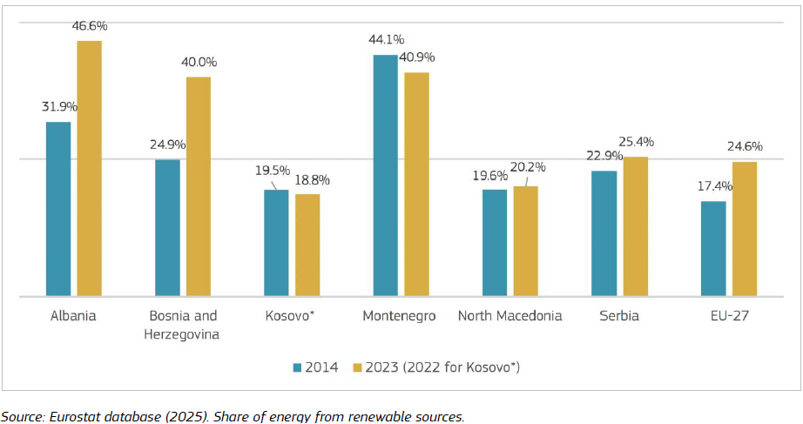
If the premises for clean energy generation are good, a lack of source diversification increases the risks related to depending solely on hydropower. Hydrological threats linked to potential damage or unexpected behaviour of water systems can lead to floods, landslides, and droughts, consequently hindering energy generation if this relies entirely on hydropower. An increased diversification of sources, integrated with solar and wind power, would therefore mitigate such risks and secure power generation even in case of damage to one specific system (Zivkovic et al., 2026).
Conclusion
Air pollution in the Western Balkans is a daily, measurable threat to citizens’ lives. Outdated coal power plants and household heating systems account for most of the damage, releasing gases and particles dangerous to human health and driving thousands of premature deaths and countless cases of respiratory illness each year, with the poorest and most vulnerable paying the highest price.
Yet the region is not without options. Hydropower already gives several countries a cleaner energy base than much of the EU, and modernising heating systems, enforcing existing emissions rules, and diversifying into solar and wind could close much of the gap.
With EU accession tying membership to environmental compliance, the region has both the tools and the incentive to act. What is needed is the political will to use them and step up in the process of achieving cleaner air for a healthier life and a fairer society.
References
Bankwatch Network. (2024, September 17). Western Balkans: Coal pollution increases due to government failures – new report - bankwatch. Bankwatch. https://bankwatch.org/press_release/western-balkans-coal-pollution-increases-due-to-government-failures-new-report
CAN Europe. (2019). Report: Eu action on Western Balkans’ chronic coal pollution is a unique opportunity to improve health and productivity - CAN Europe. CAN Europe. https://caneurope.org/publications/report-eu-action-on-western-balkans-chronic-coal-pollution-is-a-unique-opportunity-to-improve-health-and-productivity/
EEAS. (2025). Western balkans advances in environmental and climate action, but more efforts needed. EEAS. https://www.eeas.europa.eu/delegations/montenegro/western-balkans-advances-environmental-and-climate-action-more-efforts-needed_en?s=225
EFB. (2026). European Fund for the Balkans. European Fund for the Balkans. https://www.balkanfund.org/news/what-is-polluted-air-doing-to-us-in-the-western-balkans-1
Fabrègue, B. F. G. (2023, August 19). Pollution in the western Balkans (part 1): aN overview. Blue Europe. https://www.blue-europe.eu/analysis-en/full-reports/pollution-in-the-western-balkans-part-1-an-overview/
Jelisaveta Perišić. (2025, December 5). More than 330,000 europeans died due to air pollution in 2023. CENTER FOR PROMOTION OF SUSTAINABLE DEVELOPMENT. Balkan Green Energy News. https://balkangreenenergynews.com/more-than-330000-europeans-died-due-to-air-pollution-in-2023/
Joshi, D. C., Negi, P., Devi, S., Lohani, H., Kumar, R., Gupta, M., & Ming, L. C. (2025). Fine particulate matter (PM2.5, PM10): A silent catalyst for chronic lung diseases in India; a comprehensive review. Environmental Challenges, 101215. https://doi.org/10.1016/j.envc.2025.101215
Stuart, D. (2022, February 18). What are NOx and SOx and why are they important? Www.Ametek-Land.Com. https://www.ametek-land.com/pressreleases/blog/2022/february/nox-and-sox
UN Environment Programme. (2019, June 4). Air pollution is responsible for up to one in five premature deaths in 19 western balkan cities. UN Environment. https://www.unep.org/news-and-stories/press-release/air-pollution-responsible-one-five-premature-deaths-19-western
World Bank Group. (2026, March 26). Western Balkans and Ukraine take steps to transition away from coal. World Bank Group. Worldbank.Org. https://www.worldbank.org/en/news/feature/2021/11/15/western-balkans-and-ukraine-take-steps-to-transition-away-from-coal
Zivkovic, L., Fabbri, E., Strbac, D., Mitic, P., & Ljumovic, I. (2026). Energy transition in the Western Balkans. JRC Publications Repository. https://doi.org/10.2760/4713253