Kosovo: When Recognition Means Much More Than Independence
Introduction
On 17 February 2008, Kosovo unilaterally declared its independence from Serbia following years of violent conflict. While around one hundred countries have recognised Kosovo’s statehood, a considerable number of UN member states, including five EU member states, have not done so (World Population Review, 2023). As a result, the question of recognition strongly shapes Kosovo’s domestic politics, diplomatic engagement, and external ambitions, such as its accession to the European Union (Fella, 2024).
This article will first go through Kosovo’s history, explaining how it arrived at unilaterally declaring its independence, moving on to the non-recognising countries and their motives. Lastly, the implications of the lack of full international recognition for Kosovo’s economic growth, diplomatic engagement, and EU aspirations will be outlined.
History
Kosovo’s modern dispute must be understood within the late 20th century collapse of Yugoslavia. Under Yugoslav leader Josip Broz Tito, Kosovo was a province within socialist Yugoslavia, granted significant autonomy, together with the province of Vojvodina, in northern Serbia.
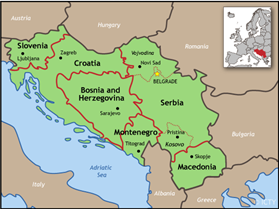
Map of the Socialist Federal Republic of Yugoslavia, January 1991 (ICTY, 2017)
During the 1990s, rising nationalist politics in Serbia, especially under Slobodan Milošević, eroded Kosovo’s autonomy and inflamed tensions between ethnic Albanians, representing the majority of Kosovo’s population, and Serbs. The ethnic Albanian community started seeking independence from Serbia, escalating in an insurgency in 1998, led by the Kosovo Liberation Army (KLA/UÇK), followed by a violent repression by the Yugoslav army (ICTY, 2017). The violence that sparked affected civilians of all the communities involved: On the one side, Serb forces indiscriminately targeted Albanian civilians, causing the death of thousands and about 800.000 refugees; on the other, the Serb community of Kosovo suffered from the KLA’s violence, leading to killings and forced displacements. According to recent counts, 13.517 people were killed or disappeared between 1998 and 2000, 77% being ethnic Albanian, 16% ethnic Serb, and the rest belonging to other ethnic groups such as Roma and Bosniak (Domanovic, 2014).
After internationally led peace deals failed, NATO intervened with a campaign of air strikes lasting for more than two months in Kosovo and Serbia. In June 1999, Serbia agreed to the establishment of a UN administration of Kosovo under Security Council Resolution 1244, withdrawing its army (ICTY, 2017).
Despite prolonged negotiations, Serbia and Kosovo failed to agree on status, leading to Kosovo’s 2008 unilateral declaration of independence, welcomed by most Western states but rejected by Belgrade and many other countries around the world, among which Russia, China, and five EU Member States. This division hardened into the current standoff over international recognition (BBC, 2018).
Who and Why does not Recognise Kosovo’s Independence
Serbia
Despite persistent tensions, the Belgrade-Pristina dialogue, facilitated by the EU, managed to reach some kind of stability and agreements between Serbia and Kosovo, such as Serbia’s recognition of Kosovo’s ID cards (Isufi, 2022). Nevertheless, Serbia insists Kosovo is an integral part of its sovereign territory, based on constitutional law and historical claims. Under the principle of territorial integrity, Belgrade rejects Kosovo’s 2008 declaration of independence, seen as an illegitimate secession. Belgrade keeps close ties with the Serb minority in Kosovo, supporting parallel institutions linked to Serbia. Additionally, Serbia continues diplomatic and domestic political campaigns to reverse recognition, especially in Africa, Asia, and Latin America (Stojanovic, 2023).
Russia and China
Both global powers align with Serbia’s position, partly to challenge Western influence in the Balkans and to uphold doctrines of state sovereignty and territorial integrity, principles they invoke regarding their own internal issues, such as separatist movements within their borders. Their positions also allow them to block Kosovo’s UN membership through veto power in the Security Council.
Russia sees Kosovo’s 2008 unilateral declaration of independence as a violation of Serbia’s sovereignty and territorial integrity. This stance is also backed by strong historical ties between Russia and Serbia, as well as strategic interests to counter Western influence in the partner country. As a permanent member of the UN Security Council, Moscow employs its UN veto power to block Kosovo’s international recognition and its membership in the UN. Meanwhile, it also reinforces its popularity among the Serbian population and political leaders, receiving in exchange support in its own geopolitical moves. For example, although Serbia condemned Russia’s 2014 and 2022 invasions of Crimea and Ukraine, it did not align with EU sanctions against Russia (Samorukov, 2019).
Similarly to Russia, China does not recognise Kosovo’s independence due to its commitment to sovereignty and territorial integrity. If fully recognised, Kosovo’s unilateral declaration of independence from Serbia could set a dangerous precedent that could affect China’s territorial claims. Furthermore, Beijing keeps strong strategic ties with Serbia, especially within the Belt and Road Initiative and other business opportunities (Ilazi & Vladisavljev, 2023).
Non-Recognising EU Member States
Five EU member states do not recognise Kosovo: Spain, Greece, Slovakia, Romania, and Cyprus. Their reasons vary but often include domestic concerns about separatist movements and fears of setting legal or political precedents for internal independence claims, such as in the case of Catalunya and Northern Cyprus (Weizman, 2025; Cleaver, 2024).
Similarly, Greece is committed to Serbia’s territorial integrity and is also concerned about the wider regional stability and the risks of emulation of unilateral secessions that could influence the Cyprus’ dispute. Athens has repeatedly called for an official agreement between the two parties (Euronews Albania, 2023).
Slovakia’s position is moved by strong historical and political ties with Serbia and a solid belief in the principle of territorial integrity, also raised against Russia’s attacks on Ukraine. Despite the formal non-recognition, Slovakia maintained a Liaison Office in Kosovo for years, although its diplomatic engagement was recently downgraded (Nič, 2019).
Lastly, Romania, which also fears its ethnic minorities seeking autonomy, raises concerns over international law and potential regional instability. Bucharest reiterates that the issue should be solved through formal agreements between Serbia and Kosovo (Chiriac, 2015).
Other global non-Recognisers
Across Asia, Africa, and Latin America, countries with internal ethnic autonomy issues or strong adherence to non-interference in sovereign matters also withhold recognition, citing concerns about precedents for separatism and challenges in applying international law uniformly (Fella, 2024).
These states often maintain strong ties with Russia and China, which, as previously mentioned, do not recognise Kosovo’s independence. Moreover, Belgrade is also continuously engaged in diplomatic efforts with third countries in order to prevent Kosovo’s recognition.
Implications for Present Politics and the EU Accession Process
The lack of full recognition creates various challenges for Kosovo on the domestic, international, and EU levels.
Domestic Politics & Stability
The recognition issue remains a core political theme in Kosovo, shaping electoral campaigns, national identity, and public discourse. Political leaders often face pressure to advance Kosovo’s international legitimacy, but the relationship between the Albanian majority and the Serb community remains complex and tense, affecting the internal political dynamics.
While restricted trade and economic growth are also linked to internal structural issues, informal economy, and a small industrial base, the lack of full recognition exacerbates this situation. Kosovo remains excluded from multiple international organisations, which could facilitate its market’s growth, such as the World Trade Organization, and its ability to sign trade agreements with third countries is persistently limited (Choi, 2017). Even the potential of Foreign Direct Investments is narrow, mostly relying on diaspora remittances.
The continued stagnation, widespread corruption, disillusionment, and unresolved status have the potential of fuelling heightened tensions and instability, potentially leading to a resurgence of conflict (Montes, 2014).
International Representation
Without universal recognition, Kosovo’s participation in international organisations remains incomplete. Although it has secured membership in the IMF and World Bank, it cannot join the United Nations. Many multilateral bodies, such as UNESCO and Interpol, remain out of reach, affecting many sectors, from cultural representation to law enforcement cooperation.
The exclusion at the international level generates obstacles such as a weak multilateral diplomacy, the unlikelihood of joining military pacts such as NATO, and difficulties in establishing diplomatic relations with non-recognising countries. Of course, citizens' movement and travel to third countries remain widely dependent on visa approvals (Szeląg, 2024).
EU Accession and Normalisation with Serbia
Kosovo formally applied for EU membership on 15 December 2022, but the lack of unanimous recognition within the Union hampers the accession process. All member states must recognise Kosovo before complete accession is possible (European Commission, 2025). Although some EU institutions have discontinued its use, namely the European Parliament and the Committee of the Regions, many EU official documents use a special “Kosovo footnote” to navigate this complex situation, permitting cooperation while not prejudging status.
Normalisation of Kosovo-Serbia relations through the EU-facilitated dialogue remains central to accession prospects. Brussels sees progress here as a prerequisite for deeper integration, yet talks have stalled amid disagreements over autonomy for Serb communities and mutual recognition.
While Kosovo signed a Stabilisation and Association Agreement with the EU and takes part in multiple EU-led initiatives, such as Horizon Europe, its full EU membership remains impossible without unanimous recognition by all current EU member states (European Commission, 2025).
Conclusion
Kosovo’s struggle for universal recognition illustrates the persistent tension between self-determination and territorial integrity in international politics. Despite significant support from Western countries and integration into some global institutions, the unresolved dispute with Serbia, also reinforced by the positions of Russia, China, and key EU member states, continues to limit Kosovo’s international footprint.
While the war ceased, the consequences of this status are tangible. At the domestic level, the lasting instability between Belgrade and Pristina, as well as tense interethnic relations, continue to hinder opportunities and living standards inside of Kosovo, limiting security, movement, and development. At the international level, Kosovo remains mostly excluded from many international organisations, and the non-recognition by EU member states represents a structural barrier to EU membership.
Kosovo’s status proofs that recognition is not simply symbolic. Instead, it shapes Kosovo’s diplomatic reach, economic potential, and ability to join the European Union. Without a diplomatic breakthrough, whether through increased recognition or a legally binding normalisation agreement with Serbia, Kosovo’s journey toward full international acceptance is likely to remain uneven and contested.
References
BBC. (2018, January 16). Kosovo profile. BBC News. https://www.bbc.com/news/world-europe-18328859
Chiriac, M. (2015, October 28). Romania Sticks to its Tough Line on Kosovo. Balkan Insight. https://balkaninsight.com/2015/10/28/romania-continues-not-to-recognize-kosovo-10-28-2015/
Choi, J. (2017, November 16). The Costs of Not Being Recognized as a country: the Case of Kosovo. Brookings. https://www.brookings.edu/articles/the-costs-of-not-being-recognized-as-a-country-the-case-of-kosovo/
Cleaver, T. (2024, April 19). Cyprus “consistent” on Kosovo non-recognition. Cyprus-Mail.com. https://cyprus-mail.com/2024/04/19/cyprus-consistent-on-kosovo-non-recognition
Domanovic, M. (2014, December 10). List of Kosovo War Victims Published. Balkan Insight. https://balkaninsight.com/2014/12/10/kosovo-war-victims-list-published/
Euronews Albania. (2023, May 1). Will Greece recognize Kosovo? Here’s what the former Foreign Minister says | Euronews Albania. Euronews.al. https://euronews.al/en/will-greece-recognize-kosovo-the-former-foreign-minister-speaks/
European Commission. (2025, December 29). Kosovo. Enlargement and Eastern Neighbourhood. https://enlargement.ec.europa.eu/countries/kosovo_en
European Union Employment Advisor. (2023, March 29). Kosovo footnote | EU, UN, Council of Europe standard. European Union Employment Advisor. https://euemployment.eu/kosovo-footnote-eu-un-coe/
Fella, S. (2024, October 18). Kosovo: developments since 1999 and relations with Serbia. House of Commons Library. https://commonslibrary.parliament.uk/research-briefings/cbp-10012/
ICTY. (2017). What Is the Former Yugoslavia ? | International Criminal Tribunal for the Former Yugoslavia. Icty.org. https://www.icty.org/en/about/what-former-yugoslavia
Ilazi, R., & Vladisavljev, S. (2023, December 28). The Implications of China-Serbia Relations for Kosovo. Thediplomat.com. https://thediplomat.com/2023/12/the-implications-of-china-serbia-relations-for-kosovo/
Isufi, P. (2022, August 31). Serbia Reminds Kosovo: ID Cards Deal Doesn’t Imply Recognition. Balkan Insight. https://balkaninsight.com/2022/08/31/serbia-reminds-kosovo-id-cards-deal-doesnt-imply-recognition/
Montes, R. (2014). Kosovo: Multiple Crises and a Challenging Future. Cidob.org. https://www.cidob.org/publicaciones/kosovo-multiple-crises-and-challenging-future
Nič, M. (2019). Slovakia: Diplomatically Engaged with Kosovo, but No Recognition. The Politics of Recognition and Engagement, 147–171. https://doi.org/10.1007/978-3-030-17945-8_8
Samorukov, M. (2019). A Spoiler in the Balkans? Russia and the Final Resolution of the Kosovo Conflict. Carnegie Moscow Center. https://carnegie.ru/2019/11/26/spoiler-in-balkans-russia-and-final-resolution-of-kosovo-conflict-pub-80429
Stojanovic, M. (2023, January 5). Serbian President Claims “Nine More Kosovo Recognition Withdrawals.” Balkan Insight. https://balkaninsight.com/2023/01/05/serbian-president-claims-nine-more-kosovo-recognition-withdrawals/
Szeląg, P. (2024). The „limited recognition” problem and the international presence of the Republic of Kosovo. Balcanica Posnaniensia Acta et Studia, 31, 299–330. https://doi.org/10.14746/bp.2024.31.15
Weizman, J. (2025). Spain rejects proposal on recognising Kosovo. The European Correspondent. https://europeancorrespondent.com/en/r/spain-rejects-proposal-on-recognising-kosovo
World Population Review. (2023). Countries That Recognize Kosovo 2021. Worldpopulationreview.com. https://worldpopulationreview.com/country-rankings/countries-that-recognize-kosovo