Equal on Paper: Women in the Western Balkans between Historical Legacy and Structural Barriers
Introduction
Across the Western Balkans, women are more educated than ever, increasingly visible in public life, and formally protected by modern equality laws. Yet, they continue to face lower employment rates, persistent wage gaps, limited political influence, elevated levels of unpaid care work, and widespread gender-based violence. Figures signal that progress has been uneven, fragile, and often dependent on external pressure rather than genuine political commitment.
By examining key social, economic, and political indicators across the Western Balkans, this article will explore the structural barriers that continue to limit women’s participation in public and private life.
A Layered Historical Legacy
The current condition of women in the Western Balkans cannot be understood without considering the region’s complex historical and cultural legacy, shaped by multiple dominations and regime changes. Overlapping layers of tradition, socialism, conflict, and political transition have been shaping gender roles, social expectations, and institutional practices.
From Patriarchal Traditions to Socialist Emancipation
For much of the XX century, societies in the Western Balkans were deeply rooted in patriarchal norms. Family structures were largely hierarchical, with men occupying positions of authority and women primarily responsible for domestic work and caregiving. In rural areas in particular, women’s access to education, employment, and public life was limited, and social status was linked to marriage and motherhood (Danaj, 2021).
Following the Second World War, the Socialist period introduced a radical shift. In Yugoslavia and Albania, communist regimes promoted formal gender equality as part of their broader ideological project. Women were encouraged to join the workforce, access education, and participate in political organisations. State-provided childcare, maternity benefits, and employment guarantees enabled many women to achieve a degree of economic independence unprecedented in the region’s history.
However, this “emancipation from above” had important limitations. Similarly to many other places in the world, also in Western countries, while women became visible in the workforce, decision-making power remained in male hands, and domestic responsibilities continued to fall disproportionately on women.
Post-Socialist Transition and the Return of Traditional Norms
The collapse of socialism in the 1990s brought profound economic and social disruption. Quick and uncontrolled privatisation, deindustrialisation, and rising unemployment affected women particularly hard, as many lost stable public-sector jobs and social protections. At the same time, welfare systems weakened, and childcare and social services were reduced or commercialised.
In this context of insecurity, traditional gender roles re-emerged. Political and religious actors increasingly promoted conservative narratives centred on “family values”, motherhood, and women’s role as caregivers. In several countries, nationalism and identity politics reinforced idealised images of women as symbols of cultural continuity and moral stability. Ultimately, many of the gains achieved under socialism were partially reversed in practice, even when legal frameworks formally remained in place (Hozić, 2024).
War, Migration, and Social Fragmentation
Armed conflicts in the former Yugoslavia during the 1990s further reshaped gender dynamics. Displacement, poverty, and wartime violence, including systematic sexual abuse, disproportionately affected women. At the same time, many assumed new responsibilities as heads of households, community organisers, and peace activists, challenging traditional roles merely centered on care (Haider, 2018).
Large-scale migration since the 1990s has also influenced women’s conditions. While emigration has offered economic opportunities, especially thank to remittances, the lack of men in the countries of origins has often increased care burdens for women left behind and contributed to demographic decline (Hozić, 2024).
Key Indicators: Where Do Women Stand Today?
Today, multiple indicators can help us understand the conditions of women in the six Western Balkan countries, particularly monitoring their education, employment and economic situation, political representation, and health and social rights.
Education
Women represent a slightly higher share of tertiary education students in the Western Balkans, representing about 56% of enrolled students in the period 2015-2018 (Regional Cooperation Council, 2020). While women's participation in STEM subjects remains lower than men's overall, disaggregating the subjects shows a reversal, with female participation reaching higher levels than the EU average. Women overrepresent men in natural sciences, mathematics, and statistics, especially in North Macedonia, which increased its female STEM students by 65% in recent years (Regional Cooperation Council, 2020).
A large “reversed” gender gap appears when looking at doctoral graduates: here, female PhD graduates outperform men, especially in Albania and Montenegro, where women account for 66% and 64% of doctoral graduates, respectively (European Commission, 2025).
Employment & Economy
Women as a category result to be particularly vulnerable economically, as the female employment rate in all six Western Balkan economies remains significantly lower than that of men, with an average gap of about 20%.
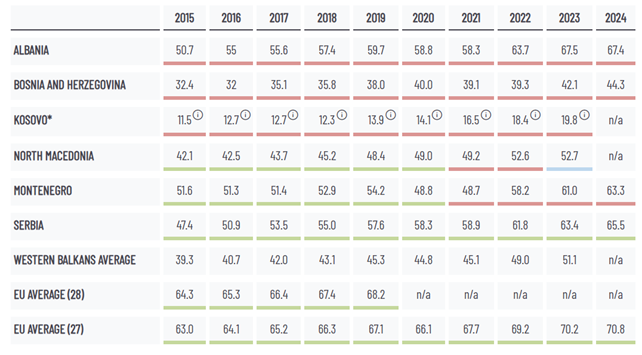
Employment rate - % of population age 20-64, female (Regional Cooperation Council)
While women are heavily represented in low-paid positions in care sectors such as teaching, health, and public services, where they represent almost 80% of workers, they are persistently underrepresented in higher-paid and managerial roles, as well as in business ownership (Western Balkans Info Hub, 2023).
However, it is important to consider that official statistics about employment often focus on legally registered jobs, meaning under a formal work contract, while missing the shares of black work. Indeed, women in the Western Balkans disproportionately account for higher rates in the informal economy, and perform unpaid work three times more than men (UNDP, 2023).
Political Representation
Although it is increasing, women’s representation in politics remains moderate and highly linked to gender quota requirements. On average, women hold about 31% of seats in national parliaments in the Western Balkans, far from achieving a gender balance (OECD, 2020). North Macedonia registers the highest rate, reflecting the 40% gender quota for candidate lists (Equal Future, 2025).
At the government level, in 2020, women held on average 27% of ministerial roles, marking an 18% increase from 2012 (OECD, 2020). Before an early 2026 reshuffling of ministers, the Albanian government awarded itself with being the best gender-balanced cabinet in the region, with a perfect 50-50 division (Kryeministria, 2025). However, while the share of female MPs and Ministers has increased in recent years, leadership roles such as party leaders and heads of government, as well as at the local level in the form of mayors, remain overly masculine (OECD, 2021).
Despite transmitting a signal of gender balance and representation, mere political representation should not be considered as a guarantee for gender-careful policies.
Health & Social Rights
Across the Western Balkan countries, issues related to cost, lack of insurance coverage, and inadequate service provision, keep imposing significant barriers for women and girls’ access to sexual and reproductive health services. These obstacles affect women’s ability to make informed decisions about their bodies and reproductive lives. Similarly, information and education on sexual and reproductive health remain limited, with services often not fully integrated into universal health coverage plans (UNFPA, 2024b).
Maternal mortality has consistently declined, meaning that fewer women die from causes connected to pregnancy and childbirth, but it remains higher than the EU average, sparking concern about the inequality and uneven access to quality care (WHO, 2025).
Gender-Based Violence and Safety
Fomented by a deeply-rooted patriarchal culture, gender-based violence still represents a major issue affecting women in the Western Balkans. It is estimated that nearly half of the women in Bosnia and Herzegovina have experienced abuse, including physical, sexual, or psychological. Yet, 84% of these incidents are not reported to the authorities. In Albania and Kosovo, a third of women have faced sexual harassment. Femicide, as the final act of violence against women, also registers worrying numbers throughout the region (Chen & Domi, 2024).
Such figures highlight the widespread nature of violence, but also the significant gap between lived experiences and official reporting: Indeed, while domestic violence affects many women, it is also seen as a private family issue which is discouraged to be reported (World Bank Group, 2024).
Main Structural Barriers
Despite the legal frameworks and formal commitments, deeply-rooted structural barriers continue to limit women’s rights and women’s opportunities across the Western Balkans. Such obstacles operate at institutional, economic, social, and cultural levels, reinforcing gender inequality in both public and private life.
Institutional weakness represents one of the most persistent barriers, leaving laws and policies on paper, with weak implementation. Western Balkan economies have established gender equality bodies and national strategies, yet these institutions frequently suffer from limited capacity, low budgets, and minimal influence on mainstream policymaking (European Parliament, 2017). As a result, gender equality is often deprioritised compared with economic or political challenges (Oliver-Burgess et al., 2020).
The unequal and often missing access to affordable, quality childcare also represents a major structural barrier to women’s economic participation. As childcare still widely relies on women, limited early childhood education and care provisions in the region translate into a forced choice for women to prioritise care over formal employment (OECD, 2022). In addition, the region’s social protection systems are strained, further worsening this situation, and historical fragmentation of welfare and erosion of services during post-socialist transitions have left gaps in support for families and people with care responsibilities, disproportionately affecting women (Osservatorio Balcani e Caucaso, 2023).
On a policymaking level, conservative narratives about “family values” both in politics and in the media have been employed to resist gender equality reforms. The political framing of gender equality as a threat to national identity, tradition, and social cohesion has turned into a tool to limit support for gender-responsive policies, reduce funding for gender equality initiatives, and justify the rollback of progressive legislation, particularly targeting reproductive rights and anti-discrimination protections (RYDE, 2024).
Lastly, the deeply rooted patriarchal norms in the Western Balkan societies continue to shape expectations about gender roles at home, work, and in public life. Cultural traditions and expectations of women as caregivers intersect with economic structures and constrain women’s opportunities and career projects. These norms are reproduced through educational systems, family practices, community expectations, and socialisation, making informal gender biases difficult to eradicate (Gov UK, 2017).
Conclusion
The condition of women throughout the Western Balkan region has historically gone through multiple waves of regimes and transitions that shaped women’s participation in public and private life. As social attitudes often change more slowly than laws, even where progressive legislation exists, informal norms, family pressure, and workplace practices continue to limit women’s autonomy and opportunities.
Today, women are increasingly participating in the education system and in the workforce, expressing their willingness for career prospects and economic independence. Nevertheless, their presence in the economy remains low and concentrated in care sectors and the informal economy. Formal labour participation gaps translate into economic vulnerability, lower social protection, and reduced career progression. Regarding issues such as gender-based violence and gendered health outcomes, the lack of consistent data collection weakens the policymaking capacity (EIGE, 2023).
Throughout the region, the responsibility for promoting gender equality remains disproportionately carried by civil society. Grassroots organisations and NGOs embody multiple complementary roles, such as providing essential services, advocacy, and policy expertise, as well as directing cultural and structural change. At the forefront of local advocacy and empowerment initiatives, bottom-up activism strives for strengthening women’s agency, working closely with international organisations to guarantee legal protections and improve women’s access to justice, filling gaps left by state institutions (WAVE, 2024).
Gender equality is a fundamental principle of the European Union and a legal and political requirement for the accession process, reinforced by international conventions such as the Council of Europe Convention on Preventing and Combating Violence Against Women and Domestic Violence, known as the Istanbul Convention. While candidate countries are required to adopt legislation aligned with EU standards on non-discriminatory and equality provisions, the current situation highlights a general lack of policymakers’ willingness to implement policies that can dismantle the political, economic, and social barriers that keep women at the margins of public and private life (Lilyanova, 2018).
In a region striving for democratic consolidation and European integration, gender equality is not only a matter of symbolic rights. It is a test of institutional credibility and social maturity which Albania, Bosnia and Herzegovina, Kosovo, Montenegro, North Macedonia, and Serbia need to demonstrate in order to guarantee an equal future for their citizens.
References
Chen, A., & Domi, T. (2024, May 3). It is time to take action and stop femicide in the Western Balkans. Euronews; Euronews.com. https://www.euronews.com/my-europe/2024/05/03/women-are-being-murdered-in-the-western-balkans-and-it-is-time-to-take-action
Council of Europe. (2023, October 2). La Convenzione di Istanbul entra in vigore per l’Unione europea. Portal; Council of Europe. https://www.coe.int/it/web/portal/-/istanbul-convention-enters-into-force-in-respect-of-the-european-union
Danaj, E. (2021, December 9). Violences contre les femmes et patriarcat : le cas des Balkans occidentaux - Fondation Jean-Jaurès. Fondation Jean-Jaurès. https://www.jean-jaures.org/publication/violences-contre-les-femmes-et-patriarcat-le-cas-des-balkans-occidentaux/
EIGE. (2023, May 11). Strengthening data systems on violence against women in the Western Balkans and Türkiye. European Institute for Gender Equality. https://eige.europa.eu/publications-resources/publications/strengthening-data-systems-violence-against-women-western-balkans-and-turkiye
Equal Future. (2025). North Macedonia | Equal Future. Equalfuture-Eurasia.org. https://www.equalfuture-eurasia.org/womens-representation-in-politics-and-public-administration/north-macedonia
European Commission. (2025, February 11). She Figures report 2025 – westernbalkans-infohub.eu. Westernbalkans-Infohub.eu. https://westernbalkans-infohub.eu/documents/she-figures-report-2025/
European Parliament. (2017). Rights and empowerment of women in the Western Balkans | Think Tank | European Parliament. Europa.eu. https://www.europarl.europa.eu/thinktank/en/document/EPRS_BRI%282017%29607273
Gov UK. (2017, July 26). Gender norms in the Western Balkans. GOV.UK. https://www.gov.uk/research-for-development-outputs/gender-norms-in-the-western-balkans
Haider, H. (2018, September 17). Gender and Conflict in the Western Balkans - Institute of Development Studies. Institute of Development Studies. https://www.ids.ac.uk/publications/gender-and-conflict-in-the-western-balkans/
Hozić, A. A. (2024). Insecurity and Economies of Care | Western Balkans Center. Westernbalkanscenter.org. https://westernbalkanscenter.org/article/insecurity-and-economies-of-care
Kryeministria. (2025). Ministrat - Albanian Government Council of Ministers. Albanian Government Council of Ministers. https://www.kryeministria.al/en/qeveria/
Lilyanova, V. (2018). BRIEFING EPRS | European Parliamentary Research Service. https://www.europarl.europa.eu/RegData/etudes/BRIE/2018/625139/EPRS_BRI%282018%29625139_EN.pdf
OECD. (2020). Government at a Glance: Western Balkans. OECD. https://doi.org/10.1787/a8c72f1b-en
OECD. (2021). Multi-dimensional analysis of development in Bosnia and Herzegovina: Multi-dimensional Review of the Western Balkans. OECD. https://www.oecd.org/en/publications/multi-dimensional-review-of-the-western-balkans_4d5cbc2a-en/full-report/component-17.html
OECD. (2022). Overview: Making the Western Balkans an attractive place to live, work and invest in: Multi-dimensional Review of the Western Balkans. OECD. https://www.oecd.org/en/publications/multi-dimensional-review-of-the-western-balkans_8824c5db-en/full-report/component-6.html
Oliver-Burgess, A., Babović, M., Popovicki, A., & Scippa, D. (2020). USAID SERBIA FINAL GENDER ANALYSIS REPORT. https://banyanglobal.com/wp-content/uploads/2020/05/USAID-Serbia-Final-Gender-Analysis-Report.pdf
Osservatorio Balcani e Caucaso. (2023). Tutela e inclusione sociale nei Balcani Occidentali - Osservatorio Balcani Caucaso Transeuropa. Osservatorio Balcani Caucaso Transeuropa. https://www.balcanicaucaso.org/cp_article/tutela-e-inclusione-sociale-nei-balcani-occidentali/
Regional Cooperation Council. (2020). Regional Cooperation Council | Economic Benefits of Gender Equality and Women Empowerment in the Western Balkans Six. Rcc.int. https://www.rcc.int/pubs/114/economic-benefits-of-gender-equality-and-women-empowerment-in-the-western-balkans-six
Regional Cooperation Council. (2025). Social Scoreboard of Indicators 2025. Esap.online. https://www.esap.online/social_scoreboard/indicators.htm
RWLSEE. (2020, September 27). About RWLSEE - RWLSEE. RWLSEE. https://rwlsee.org/who-we-are/about-rwlsee/
RYDE. (2024, October 11). Countering Attempts to Retraditionalize Gender Roles in Western Balkan Societies - POLITEIA. POLITEIA. https://politeia.institute/en/countering-attempts-to-retraditionalize-gender-roles-in-western-balkan-societies/
UN Peacekeeping. (2021). Women-Led NGOs fuel the Kosovo Trustbuilding Platform. United Nations Peacekeeping. https://peacekeeping.un.org/en/women-led-ngos-fuel-kosovo-trustbuilding-platform
UNDP. (2023). WOMEN IN WESTERN BALKAN ECONOMIES IN A NUTSHELL. https://www.undp.org/sites/g/files/zskgke326/files/2024-01/report_on_women_in_wb_economies_in_a_nutshel_17.02.2023_1.pdf
UNFPA. (2024a). UNFPA and Austria expand programme promoting gender-responsive family policies in Western Balkans. UNFPA EECA. https://eeca.unfpa.org/en/news/unfpa-and-austria-expand-programme-promoting-gender-responsive-family-policies-western-balkan-0
UNFPA. (2024b). Western Balkans health system experts commit to speeding up access to sexual and reproductive health services and rights as a key strategy to advance reproductive health for all. UNFPA the Former Yugoslav Republic of Macedonia. https://northmacedonia.unfpa.org/en/news/western-balkans-health-system-experts-commit-speeding-access-sexual-and-reproductive-health
WAVE. (2024, December 12). Civil Society Strengthening Platform - WOMEN AGAINST VIOLENCE EUROPE. WOMEN against VIOLENCE EUROPE. https://wave-network.org/civil-society-strengthening-platform/
Western Balkank Info Hub. (2023, September 12). Overview of the gender dimension in the Western Balkans – westernbalkans-infohub.eu. Westernbalkans-Infohub.eu. https://westernbalkans-infohub.eu/documents/focus-article-overview-of-the-gender-dimension-in-the-western-balkans/
WHO. (2025, April 7). Statement – Every mother’s life matters. Who.int; World Health Organization: WHO. https://www.who.int/europe/news/item/07-04-2025-statement-every-mothers-life-matters
World Bank Group. (2024). How to Address Gender Based Violence in the Western Balkans. Worldbank.org. https://www.worldbank.org/en/news/opinion/2024/12/09/16-days-of-activism-how-to-address-gender-based-violence-in-the-western-balkans