North Macedonia, Bilateral Disputes and a Power Game
Introduction
“This historic agreement shows that even the most intractable issues can be resolved through dialogue and political will.” (United Nations, 2019)
With these words, the UN Secretary General Antonio Guterres described the Prespa Agreement signed by North Macedonia and Greece, which put an end to a decades-long dispute between the two neighbouring countries. Nevertheless, the history of bilateral disputes involving North Macedonia is still ongoing and obstructing the country’s path towards EU accession.
From the outside, for someone who is not accustomed to the history of the Balkan countries, such disputes might sound silly and unimportant, failing to understand the real issues that lie behind. This article will try to explain the disputes between North Macedonia and its neighbouring countries, Greece and Bulgaria, outlining their causes, developments, consequences, and resolution.
North Macedonia and Greece: A Happy Ending?
The dispute between North Macedonia and Greece has its origin in the claims of both countries over the legacy of the Ancient Kingdom of Macedon, the figure of Alexander the Great, and the name “Macedonia”.
Geographically, the name “Macedonia” refers to a region in the Balkan peninsula which goes from the Western border of today's country of North Macedonia to the Northeast of Greece and part of Bulgaria. But politically, Macedonia is also the name of the Northeastern Greek region, the second largest in Greece, with Thessaloniki as the main city.
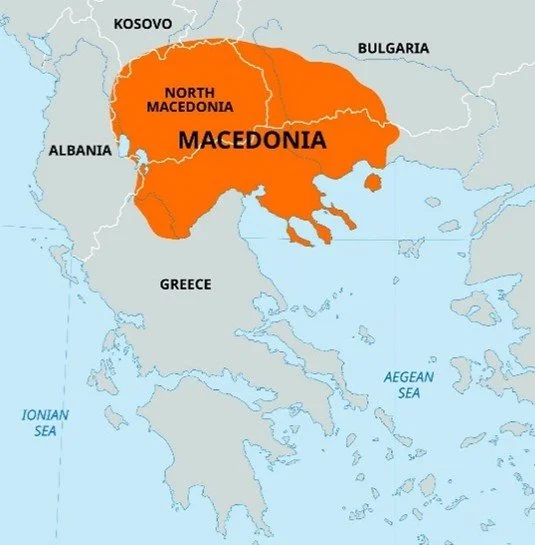
Map of the geographical region of Macedonia (Danforth, n.d.)
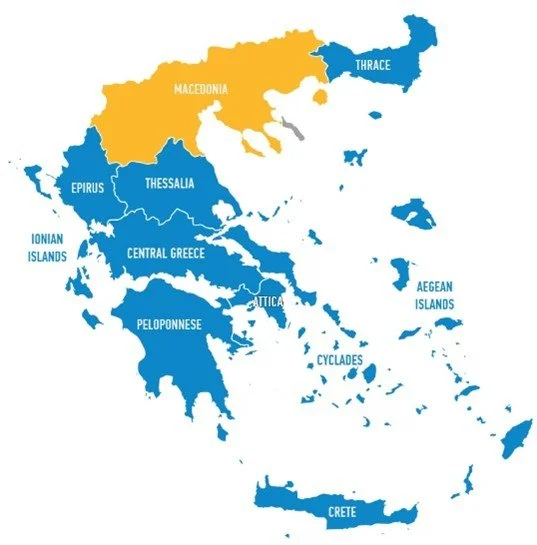
Map of the Greek region of Macedonia (MICE, 2017)
Since North Macedonia’s independence from Yugoslavia in 1991, Greece has never accepted the use of the name “Macedonia” by the neighbouring country, also using its Member State veto power to block North Macedonia’s accession to NATO and the EU until an acceptable solution was found. The reason for Greece’s stance was the fear of appropriation of identity: the Ancient Kingdom of Macedonia continues to represent a reason for pride for the Greek population due to its achievements in spreading the Hellenic culture throughout the Balkan peninsula, the Middle East, part of modern Egypt, Iran and Pakistan. Therefore, the Greek region of Macedonia is still considered by its inhabitants as the geographic and cultural heir of the ancient Kingdom, and any use of the name Macedonia outside the region is considered an appropriation of that legacy (Nimetz, 2020).
These narratives are especially instrumentalised by Greek nationalist parties, in opposition to the Macedonian nationalist parties, which counter them with theories on the self-determination of the national identity, and historical and geographical arguments.
The history of North Macedonia is characterised by subsequent dominations under the Ottoman Empire first and Bulgarian and Serbian rule later, all denying the existence of a Macedonian identity and language. It was only once Macedonia became a constituent Republic of the Socialist Federal Republic of Yugoslavia that the Macedonian nation, language, and culture were officially acknowledged. According to the Macedonian claims, the history of North Macedonia, therefore, followed a different path from the Greek one, taking a distance from the Hellenic nation. Another argument which supported the Macedonian position is of a historical and geographical kind. The name “Macedonia” has a long history and describes a broader geographical region in the Balkan peninsula, therefore detaching the name from the ancient Macedonian Kingdom (Danforth, 2020).
The Greek and Macedonian arguments opposed each other for decades, with a broad consensus of the local populations, which saw in these nationalist narratives a protection of their identity, history, and culture. Nevertheless, Greece’s status as a Member State of the EU and NATO allowed the country to back its claims with more leverage, using its veto power to block North Macedonia’s accession to these organisations.
The situation was finally cleared in 2018, when the Prespa Agreement was signed by the two countries’ Foreign Ministers. The Agreement established the change of the official name of the Republic of Macedonia to the Republic of North Macedonia, with its citizens called Macedonians, and Greece maintained its promise to lift its veto on North Macedonia’s NATO and EU accession.
Although the issue is formally closed, the Agreement caused a strong reshuffling of Macedonian internal politics. Relying on a polarised public opinion, with significant opposition to the name change, the nationalist VMRO-DPMNE party won the 2024 elections, installing its President and Government, unwilling to call the country by the new name. The Greek Government did not wait to react, reminding the President and the new Government to respect the Prespa Agreement, or else the further delay in North Macedonia’s EU accession process (Reuters, 2024).
Issues on the East: Bulgaria’s claims
The Prespa Agreement has been internationally recognised as an outstanding work of cooperation and peaceful reconciliation, finding a compromise and solving issues on both sides. The same cannot be said about the ongoing dispute with Bulgaria, which arose in more recent years and still lacks a solution.
In 2019, one year after the signing of the Prespa Agreement, Bulgaria insisted that North Macedonia must also acknowledge the Bulgarian roots of its language and history. After a strong rejection from Skopje, in 2020, Bulgaria blocked the start of North Macedonia’s EU accession negotiations through a veto, also demanding the constitutional recognition of a Bulgarian minority living in North Macedonia.
In 2022, France mediated a compromise which led the Macedonian government to first agree to constitutionally recognise the Bulgarian minority and implement a 2017 treaty signed by the two neighbouring countries meant to improve their relations. This progress led Bulgaria to lift its veto, and North Macedonia’s EU accession negotiations formally started (Euronews, 2022).
Nevertheless, the tensions between the two countries arose again once Bulgaria insisted on concreet guaranteer regarding North Macedonia’s constitutional amendments, receiving a strong rejection from Skopje, not willing to consult Sofia during the process. As a result of the continuous tensions, the constitutional changes and EU accession negotiations are stuck: the Bulgarian government led by PM Zhelyazkov and the current Macedonian government led by VMRO-DPMNE showed little willingness to resolve the dispute, despite the EU’s pressures.
Bulgaria’s claims are mostly related to language and identity issues, considering that the Macedonian language and national identity descend from Bulgarian roots, while North Macedonia considers its language and culture to be distinct, independent, and deserving to be respected as such. Sofia’s request to recognise the Bulgarian minority as a founding people in the Macedonian constitution represents another cause of big friction between the two countries due to the small Bulgarian population in North Macedonia: According to self-identifying census data, in 2021, there were just over 3000 Bulgarians registered in the country, mostly in the Southeastern province of Strumica (Marusic, 2023). Bulgaria disputes this number, generating further tension, since many Macedonian nationals are also Bulgarian passport holders. Indeed, in less than two decades, more than 200.000 Macedonian citizens were issued Bulgarian passports (Gazeta Express, 2025). For many Macedonians, obtaining a passport from Bulgaria, an EU member state, represents access to freedom of movement and employment opportunities within the European Union.
Today, while Bulgaria is not imposing a formal veto on North Macedonia’s EU accession negotiations, it continues to insist on North Macedonia’s stricter compliance with the 2022 agreement, and the progress is de facto blocked. The advancement of accession talks remains conditional on the constitutional amendment including the Bulgarian minority in North Macedonia’s constitution, the implementation of the 2017 Treaty of Friendship to stabilise the relationship between the two countries, and a roadmap to protect minority rights and prevent hate speech (CE REPORT, 2025).
While Bulgaria leverages its EU membership to demand concessions, North Macedonia navigates internal political divisions and national protests. The current government, led by the right-wing VMRO-DPMNE Prime Minister Mickoski, shows little willingness to comply with Bulgaria’s requests, especially if Bulgaria keeps obstructing North Macedonia’s EU membership (Testorides, 2025).
What’s in it for the future
The Prespa Agreement was accepted by the Macedonian population as a sign of hope for a soon-to-be EU accession, even if with a bittersweet taste. Nevertheless, the more recent dispute with Bulgaria, which arose only after normalising the relations between North Macedonia and Greece, once again delayed North Macedonia’s EU accession, generating further frustration, scepticism and anger towards the EU.
While the dispute with Bulgaria is ongoing, it is reasonable to think about what could happen in the future: will the issues with Bulgaria represent the last bilateral dispute for North Macedonia?
The disputes with Greece and Bulgaria have widely shown how nationalist political parties easily instrumentalise historical and identitarian narratives for political reasons, such as gaining a wider consensus and voter base. While the whole European continent is currently going through a resurgence of nationalist movements, nationalism in the Balkan region has historically dominated internal politics. The nationalists’ claims to defend national and ethnic identities and interests hold a strong grip on local support, but their rigidity and lack of willingness to negotiate inevitably obstruct regional cooperation efforts.
The Prespa Agreement was negotiated by the Macedonian and Greek left-wing governments, more eager to compromise, find a peaceful solution to a long-lasting disagreement, and create the base for a stronger partnership and better neighbourly relations. Meanwhile, nationalist political parties and movements of both countries were opposing the Agreement: Greek nationalists considered it too soft as it did not prevent the use of the name Macedonia; Macedonian nationalists protested that the Agreement was undermining the Macedonian identity (Stojanovski, 2018). In a similar way, although supported, in part or totally, by most Bulgarian political parties, the Bulgarian claims are primarily raised by right-wing nationalist political parties, such as VMRO-BNM, There’s Such a People, Vazrazhdane, and GERB (Todorov, 2022).
As more Balkan countries are negotiating their EU accession, it is legitimate to ask whether new Member States will once again employ the veto power for domestic political reasons, such as gaining more popularity and votes. While one hopes that these are all speculations and that the efforts for regional cooperation and good neighbourly relations carried out by multiple regional and EU-led initiatives have reached their goals, individualistic interests of the political elites keep threatening the region.
Conclusion
Since its independence from Yugoslavia in 1991, North Macedonia has gone through bumpy relationships with its neighbours, having to face one bilateral dispute after the other. The privileges held by Greece and Bulgaria as EU Member States represented an unbalanced situation in their disputes and requests to North Macedonia, willing to compromise to unblock its path towards EU membership. While the dispute with Greece found a peaceful solution in the Prespa Agreement, the dispute with Bulgaria has been perceived by the Macedonian citizens as yet another humiliation of their identity, fomenting a widespread frustration and lack of trust in the European Union.
Today, the EU is called to make decisions and decide its priorities. The risk of other disputes and vetoes based on nationalist claims is real, and, under the current unanimity rules, the EU lacks effective mechanisms to prevent it. Instead, the Union relies on the hope that regional cooperation initiatives will improve the relationships between the Western Balkan six and avoid more tensions between neighbours.
In a moment when it seems that while fixing a hole, water starts flowing from another, to maintain its legitimacy, the EU must find new ways and strategies to guarantee a smooth accession process to all the candidate countries, isolating those nationalist movements that need to sink others to thrive.
References
CE REPORT. (2025, April 15). Bulgaria Urges North Macedonia to Fulfill Full European Consensus for EU Accession. CE Report. https://www.cereport.eu/news/politics/83694
Danforth, L. (n.d.). Macedonia | History, Language, Name, & Facts. Encyclopedia Britannica. https://www.britannica.com/place/Macedonia-region-Europe
Danforth, L. M. (2020). The Macedonian Conflict. Princeton University Press.
Euronews. (2022, July 17). North Macedonia votes for EU deal to lift Bulgarian veto amid protests. Euronews; euronews.com. https://www.euronews.com/2022/07/17/north-macedonia-mps-vote-for-eu-proposal-lifting-bulgarian-veto-despite-protests
Gazeta Express. (2025, June 25). Sofia: Over 216 Bulgarian passports issued to citizens of North Macedonia. Gazeta Express. https://www.gazetaexpress.com/en/Sofia%3A-Over-216-Bulgarian-passports-have-been-issued-to-citizens-of-North-Macedonia/
Marusic, S. J. (2023, April 6). North Macedonia Slates “Scandalous” Bulgarian Push for Role in Constitutional Change. Balkan Insight. https://balkaninsight.com/2023/04/06/north-macedonia-slates-scandalous-bulgarian-push-for-role-in-constitutional-change/
MICE. (2017, January 9). MACEDONIA – MICE. Mice.gr. https://mice.gr/macedonia/
Nimetz, M. (2020). The Macedonian “Name” Dispute: The Macedonian Question—Resolved?. Nationalities Papers, 48(2), 205–214. https://doi.org/10.1017/nps.2020.10
Reuters . (2024, May 13). North Macedonian president’s inauguration revives name dispute with Greece. Reuters. https://www.reuters.com/world/europe/north-macedonian-presidents-inauguration-revives-name-dispute-with-greece-2024-05-13/
Stojanovski, F. (2018, June 18). Greek and Macedonian nationalists oppose agreement that would end a quarter-century name dispute. Global Voices. https://globalvoices.org/2018/06/18/greek-and-macedonian-nationalists-oppose-agreement-that-would-end-a-quarter-century-name-dispute/
Testorides, K. (2025, May 23). EU presses North Macedonia to make “era-defining” decisions for membership. AP News. https://apnews.com/article/north-macedonia-eu-kallas-balkans-1fe673017c1ae6367d0b05ca1f74b990
Todorov, S. (2022, June 8). Bulgarian Ruling Coalition Cracks over North Macedonia Dispute. Balkan Insight. https://balkaninsight.com/2022/06/08/bulgarian-ruling-coalition-cracks-over-north-macedonia-dispute/
United Nations. (2019, February 14). UN chief hails victory of “political will” in historic Republic of North Macedonia accord. UN News. https://news.un.org/en/story/2019/02/1032731